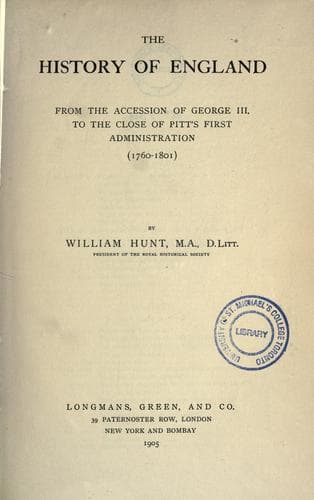
The history of England, from the accession of George III. to the close of Pitt's first administration, 1760-1801Hunt, William
History
The history of England, from the accession of George III. to the close of Pitt's first administration, 1760-1801
Hunt, William
Great Britain -- History -- George III, 1760-1820
The bill excited much disapproval and was vigorously opposed in
parliament. In the commons the preamble, which acknowledged the
prerogative asserted by the crown, was passed only by a majority of
thirty-six, and the bill was finally carried by 165 to 115. Among its
opponents were Burke and Charles Fox, by that time a power in the house.
No man probably has ever enjoyed greater popularity than Fox. His
disposition was amiable and generous, his good nature inexhaustible, his
heart full of warm and humane feelings. As a mere lad he had been
initiated into vice by his father's folly; he drank, lived loosely,
dressed extravagantly, and was an inveterate and most unlucky gambler;
his losses were indeed too constant to be wholly due to ill-luck. At
twenty-five he owed L140,000, which his father paid for him. He was a
keen sportsman, and he cared for higher things than sport. He was
accomplished, a lover of learning and art, and found unfailing pleasure
in the masterpieces of Greek, Latin, English, French, Italian, and, in
later days, Spanish literature. In parliament he had hitherto opposed
all popular measures, sometimes with insolent flippancy. He was
appointed a lord of the admiralty in 1770. He gradually came under
Burke's influence and showed signs of remarkable talents in debate. His
speeches were unprepared, his statement of a case was often made
confusedly, but he was splendid in reply. His career as a statesman was
marred, like his private character, by an utter lack of principle. His
opposition to the royal marriage bill seems to have been a matter of
private feeling. His father had united the plebeian family of Fox with a
house descended from a royal bastard by a runaway marriage with Lady
Caroline Lennox; and Charles was hot against a bill which annulled a
marriage made without legal consent, and must have derived special
satisfaction in opposing the wish to preserve the royal family from
derogatory marriages on the part of the faithless lover of his favourite
aunt, Lady Sarah. He resigned office, but re-entered the ministry the
following December.
[Sidenote: _NORTH'S REGULATING ACT._]
Public-domain text, read in full here on John Shaqi.
Reviews
Reviews
No reviews yet
Be the first to share your thoughts on this work.
Elsewhere in the archive
Join the Discussion
Join the discussion
Sign in to leave a comment or review.
Sign InorCreate an account