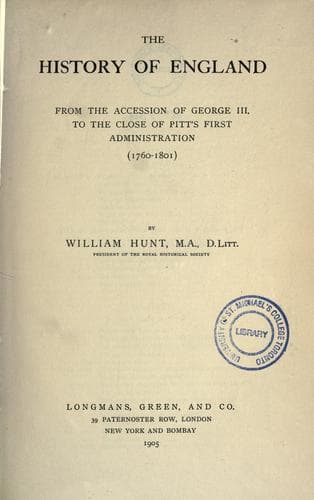
The history of England, from the accession of George III. to the close of Pitt's first administration, 1760-1801Hunt, William
History
The history of England, from the accession of George III. to the close of Pitt's first administration, 1760-1801
Hunt, William
Great Britain -- History -- George III, 1760-1820
During the debates on these measures the publication of the report of
the select committee excited public feeling against the "nabobs," and
specially against Clive, and a parliamentary inquiry was held into his
conduct. Before the select committee he admitted and defended the deceit
which he had practised on Omichand in 1757, and declared that he was
justified in accepting enormous sums from Mir Jafar. They were as
nothing compared to what he might have had; "Mr. Chairman," said he, "at
this moment I stand astonished at my own moderation". Resolutions
condemning his conduct were moved by Burgoyne. He defended himself with
force and dignity. Finally, after many debates, the house voted that he
had through the power entrusted to him possessed himself of L234,000,
refused to vote that he had abused his power, and voted instead that "he
did at the same time render great and meritorious services to this
country". The matter was not made a party question, and the decision was
worthy of the assembly which pronounced it. The king, while fully
acknowledging Clive's services, thought him guilty of "rapine," and
disapproved of his virtual acquittal. Thurlow attacked, Wedderburn
zealously defended him. The court party voted different ways. Physical
suffering together with the strain of these proceedings affected Clive's
mind, and he died by his own hand on November 22, 1774.
[Sidenote: _THE KING'S POLITICAL PREDOMINANCE._]
In 1773 the king's political predominance was firmly established. His
will was law to his ministers, and they commanded overwhelming
majorities in both houses of parliament. The country was satisfied that
it should be so, for the quarrel between the people and parliament had
died out. It was a time of political apathy. The balance of power, which
during Walpole's administration had shifted from the lords to the
commons, was shifting from parliament to the crown. The house of commons
was losing its spirit of independence, and the control which it should
have exercised on the executive was endangered by the growth of the
king's personal authority. So long as George ruled the country
successfully this danger was likely to increase. He had so skilfully
strengthened his position that he had triumphed over domestic agitation.
The just working of the constitution was finally restored through
national calamity. American discontents were to lead to a revolt which
the enemies of England used as an opportunity for attacking her. Their
attacks were formidable in themselves, and had the humiliating result of
forcing Great Britain to give up the struggle with her revolted colonies
and acknowledge their independence. George had chosen to be his own
prime minister, and his policy was to suffer defeat. A period of storm
was ahead, and as the ship of state passed through it, the king's
personal rule, and much else besides, went overboard. All this was still
far off. From 1770 to 1774 the affairs of the American colonies excited
Public-domain text, read in full here on John Shaqi.
Reviews
Reviews
No reviews yet
Be the first to share your thoughts on this work.
Elsewhere in the archive
Join the Discussion
Join the discussion
Sign in to leave a comment or review.
Sign InorCreate an account