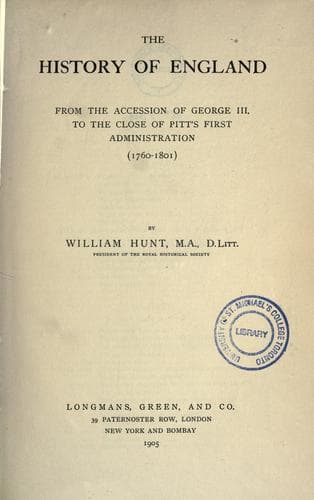
The history of England, from the accession of George III. to the close of Pitt's first administration, 1760-1801Hunt, William
History
The history of England, from the accession of George III. to the close of Pitt's first administration, 1760-1801
Hunt, William
Great Britain -- History -- George III, 1760-1820
little attention in England, though, as we shall see in the next
chapter, they were tending towards open revolt.
FOOTNOTES:
[82] _Annual Register_, xiii. (1770), 72.
[83] _Life of Shelburne_, ii., 221; Calcraft to Chatham, March 8, 1771,
MS. Pitt Papers, 25.
[84] _Speeches of Barre_, March 23, and Burke, April 6, 1773, _Parl.
Hist._, xvii., 826, 836.
[85] Calcraft to Chatham, March 12, 1770, MS. Pitt Papers, 25.
[86] _Letters of H. Walpole_, v., 238-39 _n._; Mitford, _Gray and Mason
Correspondence_, pp. 438-39; Stephens, _Memoirs of J. H. Tooke_, i.,
157.
[87] Calcraft to Chatham, June 10, 1770, MS. Pitt Papers, 25.
[88] The State of the Navy, MS. Admiralty Miscell., 567, R.O.
CHAPTER VII.
THE QUARREL WITH AMERICA.
The failure of the non-importation agreements in 1770 led Englishmen to
expect a peaceable end to the quarrel with America, and the colonists
were for the most part inclined to let it die out. Samuel Adams had no
such inclination, and did all in his power to fan the smouldering embers
of strife. For some time longer he and his friends professed loyalty,
but he at least was consciously working for separation. A rising in
North Carolina, called the regulators' war, because the insurgents
claimed to regulate their own police affairs, was smartly quelled by the
governor, Tryon, in 1771; it need not detain us, for it had no connexion
with the quarrel with England. There was much lawlessness elsewhere.
Mobs tyrannised over their more loyal neighbours, tarring and feathering
some of those who would not comply with their demands, and using other
barbarous modes of advancing the cause of liberty. In Boston the revenue
officers were exposed to insult and violence. Hutchinson held the
assembly of the province at Cambridge, and further disgusted his
opponents by informing them that he was no longer dependent on their
votes for his salary; it would thenceforward be paid by the king. The
more peaceable Americans were gratified in 1772 by the appointment of
the Earl of Dartmouth to succeed Hillsborough as secretary for the
colonies, for Dartmouth, a pious and amiable person of no political
ability, was known to be anxious for conciliation. Fresh cause of
offence, however, was found in a decision of the ministers that the
salaries of the Massachusetts judges should be paid by the crown instead
of by the colony. This change, which was designed to render the judges
independent of popular feeling, was resented as an attempt to make them
subservient to the crown, for they held office during the king's
pleasure.
[Sidenote: _HUTCHINSON'S LETTERS._]
Public-domain text, read in full here on John Shaqi.
Reviews
Reviews
No reviews yet
Be the first to share your thoughts on this work.
Elsewhere in the archive
Join the Discussion
Join the discussion
Sign in to leave a comment or review.
Sign InorCreate an account