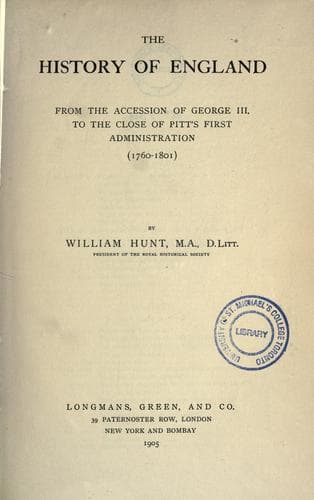
The history of England, from the accession of George III. to the close of Pitt's first administration, 1760-1801Hunt, William
History
The history of England, from the accession of George III. to the close of Pitt's first administration, 1760-1801
Hunt, William
Great Britain -- History -- George III, 1760-1820
Samuel Adams unexpectedly found an opportunity of rousing fresh
excitement in Massachusetts. A number of private letters written by
Hutchinson and Oliver, the deputy governor, to a gentleman of England,
named Whately, and stolen after his death, were sent over by Franklin to
the committee of correspondence at Boston, were read by Adams to the
assembly, and were subsequently published. Hutchinson, a patriotic
American, was a faithful servant of the crown and believed in the
supremacy of parliament. His letters contained no statements that were
not true and no comments discreditable to a man of honour, holding the
opinions on which he had consistently acted. They were declared to be
evidences of malice and bad faith; he and Oliver were, John Adams said,
"cool-thinking, deliberate villains," and the assembly sent a petition
to the king for their removal. The letters were industriously circulated
throughout the province, and were denounced by preachers in their Sunday
sermons. Such was the state of affairs when, in accordance with the act
of parliament authorising the East India Company to export its surplus
stock of tea direct to America, three ships laden with tea appeared in
Boston harbour. Other ships with like cargoes had also been despatched
to New York, Philadelphia, and Charleston. At Boston, on the night of
December 16, a large body of men, disguised as Indians and encouraged by
Samuel Adams and his friends, boarded the ships and emptied their
cargoes, 340 chests of tea valued at L18,000, into the sea. The ships
for Philadelphia and New York returned to London without discharging
their cargoes. At Charleston the tea was landed, but the consignees were
forced to renounce their engagement, and the tea rotted in the cellars
of the custom-house.
Public-domain text, read in full here on John Shaqi.
Reviews
Reviews
No reviews yet
Be the first to share your thoughts on this work.
Elsewhere in the archive
Join the Discussion
Join the discussion
Sign in to leave a comment or review.
Sign InorCreate an account