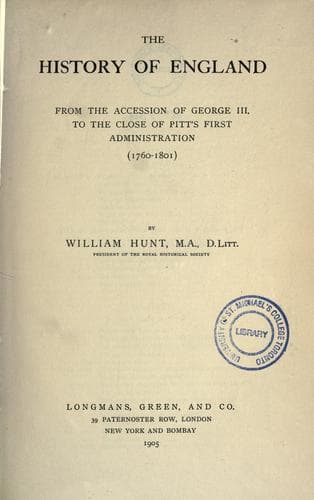
The history of England, from the accession of George III. to the close of Pitt's first administration, 1760-1801Hunt, William
History
The history of England, from the accession of George III. to the close of Pitt's first administration, 1760-1801
Hunt, William
Great Britain -- History -- George III, 1760-1820
In England the Boston riot caused much irritation. The news came when
the publication of Hutchinson's letters was exciting strong feelings.
Who was responsible for their abstraction from Whately's correspondence
was for some time a mystery. Franklin kept his counsel, and a duel took
place between Whately's brother and a Bostonian who was suspected of
stealing them. Then Franklin declared that he alone had obtained them
and sent them to Boston. As agent for Massachusetts he appeared before a
committee of the privy council on January 29, 1774, in support of the
petition against Hutchinson and Oliver. Both sides were heard by
counsel. Wedderburn, who spoke against the petition, made a violent
attack on Franklin; he described him as a thief and accused him of
acting from the meanest motives. The temper of his audience was
irritated by the news from Boston, and his speech was received with
manifestations of delight, indecent on the part of men sitting as judges
in that august court. The petition was rejected as groundless and
scandalous, and men went away "almost ready to throw up their hats for
joy," as though a lawyer's bitter tongue had given England a victory.
Franklin was at once dismissed from his office of deputy postmaster.
Wedderburn's speech and the spirit in which it was received were
impolitic as well as discreditable. While strongly opposed to the
ministerial policy in America, Franklin had shown himself anxious to
maintain the tie between Great Britain and her colonies. This attack
upon his character made him one of England's enemies, and, as it proved,
one of the most dangerous of them. His conduct is not palliated by the
indecency of his opponents. It has been urged in his defence that, as
Whately had shown the letters to certain English politicians, it was
fair that Boston politicians should also see them, that as agent he was
bound to do the best for his province, and that governments did
intercept and use correspondence which was believed to contain important
political information.[89] Conduct befitting a man of honour needs no
defence.
[Sidenote: _FOX DISMISSED FROM OFFICE._]
Public-domain text, read in full here on John Shaqi.
Reviews
Reviews
No reviews yet
Be the first to share your thoughts on this work.
Elsewhere in the archive
Join the Discussion
Join the discussion
Sign in to leave a comment or review.
Sign InorCreate an account