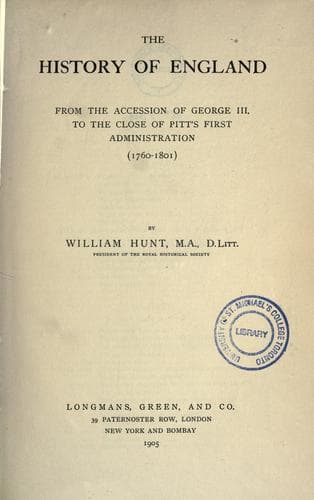
The history of England, from the accession of George III. to the close of Pitt's first administration, 1760-1801Hunt, William
History
The history of England, from the accession of George III. to the close of Pitt's first administration, 1760-1801
Hunt, William
Great Britain -- History -- George III, 1760-1820
On March 14 North began to lay before the commons the measures by which
the government hoped to bring the Americans to submission. By the first
of these penal laws, as they are called, Boston was to be punished by
the transference of the seat of government to Salem, and by the closing
of its harbour, which entailed the suspension of its trade, until the
town had made good the loss inflicted on the East India Company, and the
king was satisfied that the laws would be observed. North spoke with
remarkable moderation. Both he and Dartmouth disliked violent measures,
and their tone with regard to America was so different from that of
their colleagues, that it indicated a division in the cabinet.[90] The
bill met with little opposition in the commons, though Dowdeswell and
Burke spoke against it. In the lords, Rockingham and Shelburne opposed
it, Chatham was absent through ill-health, and Mansfield strongly
advocated it, declaring that Boston had committed "the last overt act of
treason," and that it was a lucky event, for if the bill passed we
should have crossed the Rubicon, the Americans would see that we would
temporise no longer, and if it passed unanimously, Boston would submit
without bloodshed. The bill passed both houses without a division. The
next bill, "for regulating the government of Massachusetts Bay,"
overthrew the charter of the colony; it increased the power of the
governor, vested the nomination of the council in the crown, altered the
system by which juries were chosen, and prohibited town meetings, the
principal engine of democratic rule, from being held without the consent
of the governor. The abrogation of chartered rights excited strong,
though ineffectual, opposition; the bill was passed in the commons by
239 to 64, and in the lords by 92 to 20, eleven peers signing a protest
against it.
Public-domain text, read in full here on John Shaqi.
Reviews
Reviews
No reviews yet
Be the first to share your thoughts on this work.
Elsewhere in the archive
Join the Discussion
Join the discussion
Sign in to leave a comment or review.
Sign InorCreate an account