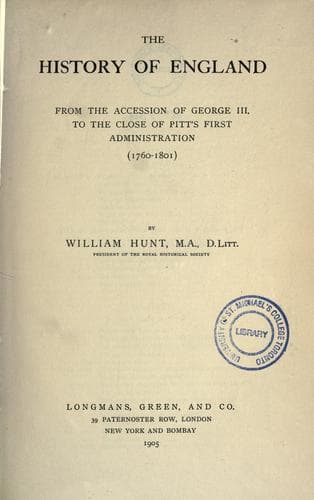
The history of England, from the accession of George III. to the close of Pitt's first administration, 1760-1801Hunt, William
History
The history of England, from the accession of George III. to the close of Pitt's first administration, 1760-1801
Hunt, William
Great Britain -- History -- George III, 1760-1820
The general opinion in England was that Boston should be punished, and
that if the government made an example of that rebellious town, the
Americans would learn a wholesome lesson. The king held this opinion,
and was delighted when General Gage told him that the Americans "would
be lions whilst we are lambs, but if we take the resolute part they will
undoubtedly prove very meek". He determined to force Boston to
submission, and his ministers were at his command. A junior lord of the
treasury was insubordinate, and was promptly dismissed. It seemed a
small matter, but it had important consequences, for the rebel was
Charles Fox. He had more than one grudge against the king, and he was
perhaps growing impatient of serving under a minister who was virtually
the king's representative, though his actual revolt may have been an
unpremeditated ebullition of youthful vanity. A libel on the speaker, of
which the turbulent parson, Horne, was the author, gave him an
opportunity for self-display; he usurped the functions of leader of the
house, persuaded it to enter on proceedings which might have ended in
another awkward quarrel with a printer, and placed North in a most
embarrassing position. The king, whom he had already offended by his
opposition to the royal marriage bill, heartily disliked him, and urged
North to get rid of him. He was curtly dismissed from office on February
24. He at once went into opposition, and acted generally with the
Rockingham party, though he did not distinctly join it until a later
period. He was already intimate with Burke, who soon gained much
influence over him. On almost every question he combated the opinions
which he had previously supported, and constantly attacked his former
chief with great bitterness. In debate the opposition gained enormously
by his alliance, but it was in the end injurious to their cause. His
sympathy with the enemies of his country in time of war strengthened the
king and his ministers in their efforts to maintain the honour of
England by persevering in the struggle, for it revolted the patriotic
feelings of the nation and kept it steadfast in its support of the
government.
[Sidenote: _THE PENAL ACTS._]
Public-domain text, read in full here on John Shaqi.
Reviews
Reviews
No reviews yet
Be the first to share your thoughts on this work.
Elsewhere in the archive
Join the Discussion
Join the discussion
Sign in to leave a comment or review.
Sign InorCreate an account