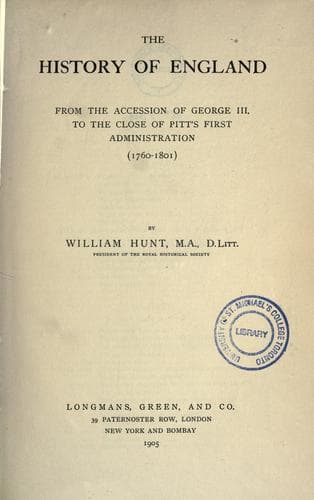
The history of England, from the accession of George III. to the close of Pitt's first administration, 1760-1801Hunt, William
History
The history of England, from the accession of George III. to the close of Pitt's first administration, 1760-1801
Hunt, William
Great Britain -- History -- George III, 1760-1820
Another bill, closely connected with the state of affairs in America,
though not devised merely with reference to it, provided for the
government of Canada, which had remained as it had been settled
temporarily by royal proclamation in 1763. The province of Quebec, as it
was called, only extended eastward to the St. John's river on the north
of the St. Lawrence, the territory beyond being annexed to the
jurisdiction of Newfoundland, while on the south the islands of Cape
Breton and St. John (Prince Edward's island) belonged to Nova Scotia.
No settlement was made as to the country west of the Appalachian range,
which was claimed by the old colonies, nor as to the vast tract between
Lake Nipissing and the Mississippi, the boundary of the Spanish land.
The government of Canada was in the hands of a military governor-general
and a council. In 1764 the English-speaking and protestant population
was a mere handful; in 1774 it numbered about 360, while the French
Roman catholics were at the least 80,000. In accordance with the treaty
of Paris the catholics had full liberty of worship. English was,
however, the only official language, and all offices were held by men of
British nationality. The administration of the law was confused, and,
though the king's proclamation held out a prospect that an assembly
might be called, it required oaths and declarations which would have
shut Roman catholics out from it. The French disliked the English law
with reference to land, and as far as possible evaded it. Constant
difficulties arose, and, in 1766, Charles Yorke, then attorney-general,
advised that English should cease to be the only official language, and
that French law should be recognised in cases which concerned land. On
the other hand the British minority, largely consisting of immigrants
from New England, pressed for an assembly, which would have strengthened
and perpetuated their supremacy over their French neighbours.
Public-domain text, read in full here on John Shaqi.
Reviews
Reviews
No reviews yet
Be the first to share your thoughts on this work.
Elsewhere in the archive
Join the Discussion
Join the discussion
Sign in to leave a comment or review.
Sign InorCreate an account