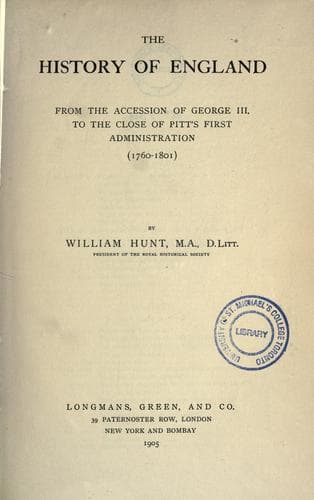
The history of England, from the accession of George III. to the close of Pitt's first administration, 1760-1801Hunt, William
History
The history of England, from the accession of George III. to the close of Pitt's first administration, 1760-1801
Hunt, William
Great Britain -- History -- George III, 1760-1820
The discontent in the American colonies made the ministers specially
anxious to conciliate the French Canadians, and with the advice of Sir
Guy Carleton, the governor, they brought in a bill for the government of
the province. The Quebec act of 1774 included in Canada the territory
previously annexed to Newfoundland, and extended its boundaries to the
Ohio and the Mississippi. It confirmed freedom of worship to the Roman
catholics and secured to their priests, with the exception of the
religious orders, their former tithes and dues, so far as concerned
their own people only, for protestants were exempted from such payments.
Civil cases were to be decided according to the French law, criminal
cases according to the English law, by juries. It was declared
inexpedient to call an assembly; a legislative council was nominated by
the crown, and taxation was reserved to the parliament of Great Britain.
The bill was strenuously opposed, Chatham in the lords, and Burke and
Barre in the commons speaking strongly against it. The government, it
was urged, was setting up a despotism and was depressing the British
population to please the French _noblesse_, and the trial of civil cases
without juries and the withholding of the _habeas corpus_ were
represented as intolerable grievances.
The conflict was hottest on the religious question. The whigs, who
secured the support of the dissenters by posing as the protestant party,
had a hereditary claim to the popular cry of No popery. They denounced
the bill as establishing popery, while it merely permitted
protestantism. It was, Chatham declared, a breach of the reformation, of
the revolution, and of the king's coronation oath. The City petitioned
against the bill, and when, on June 22, the king went to give his assent
to it and to prorogue parliament, he was received in the streets with
angry cries of "No popery". The agitation soon died out, for the
government was popular. In America the act caused much irritation; New
York, Virginia, and other colonies complained that it deprived them of
the right to extend their territories; the revolutionary party saw with
uneasiness the establishment of the power of the crown over a vast
district on their borders, and religious prejudices were aroused by the
favour shown to the catholics. Strong protestant as he was, the king was
thoroughly in favour of the bill. It was a wise and a just measure. It
gave the French Canadians all that they really needed: they thought it
absurd that rights to land should be decided by juries; they had no
political ambitions, and only desired to enjoy in peace the
ministrations of their own priests and the right to deal with their
lands according to their ancient customs. They rejoiced that their
priests were satisfied, and in the coming struggle between Great Britain
and her colonies the priests were mindful of the justice with which they
were treated and used their boundless influence with good effect on the
British side.
Public-domain text, read in full here on John Shaqi.
Reviews
Reviews
No reviews yet
Be the first to share your thoughts on this work.
Elsewhere in the archive
Join the Discussion
Join the discussion
Sign in to leave a comment or review.
Sign InorCreate an account