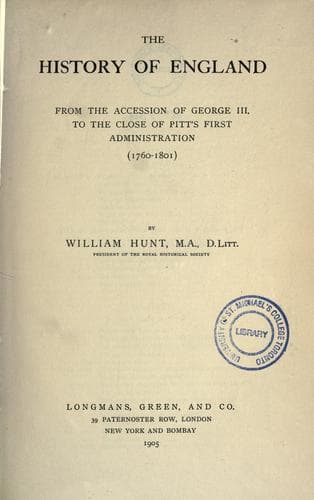
The history of England, from the accession of George III. to the close of Pitt's first administration, 1760-1801Hunt, William
History
The history of England, from the accession of George III. to the close of Pitt's first administration, 1760-1801
Hunt, William
Great Britain -- History -- George III, 1760-1820
On September 5 the continental congress met at Philadelphia. Of the
thirteen colonies only Georgia was unrepresented. Yet the delegates came
with different instructions and different intentions, and even among
delegates from the same province there was much difference of opinion.
As a body the congress did not meet with any predetermined revolutionary
purpose. Many loyalists and indeed moderate men of both parties believed
that it would be a means of arranging a reconciliation with Great
Britain, and though the most decided loyalists would have nothing to do
with it, even they hoped for a good result:[92] one-third of the
delegates, John Adams said, were whigs, one-third tories (loyalists),
and the rest mongrel. A proposal for a new constitution with a president
over all the colonies to be appointed by the crown, and a grand council
to be elected by the several assemblies and to act in connexion with
parliament, was only negatived by the votes of six colonies to five. Yet
the revolutionists gained a decided preponderance, largely through the
skilful management of Samuel Adams, who persuaded the congress to
approve the "resolves" passed at a meeting of Suffolk county,
Massachusetts. These "resolves" rejected the act for the government of
the province, required tax collectors not to pay money into the
governor's treasury, and advised towns to appoint their own officers of
militia. Besides endorsing a policy of armed resistance to government,
congress further demanded the revocation of a series of acts of
parliament, including the Quebec act and the late penal legislation,
drew up a declaration of rights, agreed on non-exportation and
non-importation, sent a petition to the king, and published an address
to the English people. It arranged that a new congress should meet the
following May, and invited the Canadians to join in it, suggesting
grounds of discontent with the English government and pretending a zeal
for religious equality. But the Canadians were not to be caught.
[Sidenote: _AMERICAN LOYALISM._]
Public-domain text, read in full here on John Shaqi.
Reviews
Reviews
No reviews yet
Be the first to share your thoughts on this work.
Elsewhere in the archive
Join the Discussion
Join the discussion
Sign in to leave a comment or review.
Sign InorCreate an account