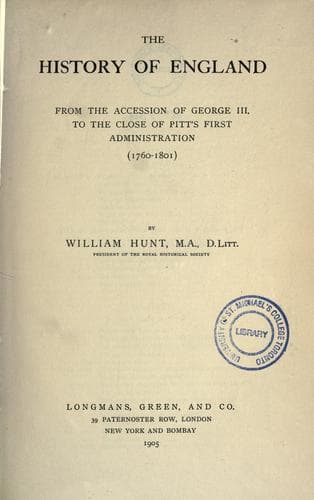
The history of England, from the accession of George III. to the close of Pitt's first administration, 1760-1801Hunt, William
History
The history of England, from the accession of George III. to the close of Pitt's first administration, 1760-1801
Hunt, William
Great Britain -- History -- George III, 1760-1820
Congress separated without having laid down any basis for conciliation
save complete surrender on the part of parliament, which was clearly
impossible. It professed loyalty to the crown, and it is probable that
certain eminent Americans, who, like George Washington, declared that
they knew of no wish for independence, really desired to maintain the
connexion with England, if they could bring affairs back to their
condition before 1763, and actually believed that by cutting off
commercial relations with her, they could compel her to assent to their
demands without an appeal to arms. Like the vast majority of Englishmen,
who did not believe that the Americans would fight, they failed to
understand the situation. In the case of others, like Patrick Henry and
the Adamses, it is useless to attach any weight to loyal expressions.
Too much, indeed, has been made of the American professions of loyalty,
for men's loyalty is better judged by their actions than by their words.
Thousands of Americans proved their loyalty by tremendous sacrifices.
Loyalism on its religious side was connected with the teaching of the
English Church; politically it was the outcome of attachment to law,
monarchy, and the unity of the empire as against revolution, democracy,
and separation.[93] The loyalists, however, included men of various
religious persuasions and of different shades of political opinion. As
Americans, they felt the British colonial system burdensome, and only
the more extreme among them approved of the stamp act and the Townshend
duties. Many took the American view of the rights of the colonies; they
desired reforms and redress of grievances, and some of them were not
averse from the milder forms of resistance. Yet all were loyal to the
crown and acknowledged the supremacy of parliament. The hopes of the
moderate section were disappointed by the congress of 1774; in common
with the more extreme loyalists they held that it exceeded its powers,
and their denial of its authority united the loyalist party.
Public-domain text, read in full here on John Shaqi.
Reviews
Reviews
No reviews yet
Be the first to share your thoughts on this work.
Elsewhere in the archive
Join the Discussion
Join the discussion
Sign in to leave a comment or review.
Sign InorCreate an account