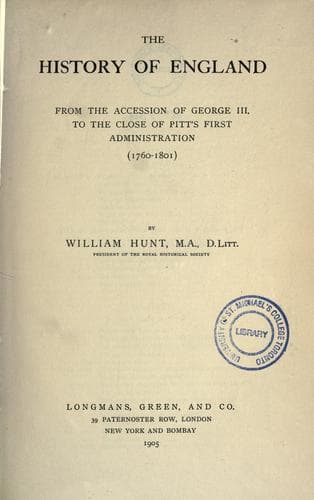
The history of England, from the accession of George III. to the close of Pitt's first administration, 1760-1801Hunt, William
History
The history of England, from the accession of George III. to the close of Pitt's first administration, 1760-1801
Hunt, William
Great Britain -- History -- George III, 1760-1820
"I am not sorry," George wrote on hearing of the proceedings of
congress, "that the line of conduct seems now chalked out; the New
England colonies are in a state of rebellion, blows must decide whether
they are to be subject to this country or independent." He expressed the
feeling of by far the larger part of his people. Not of all, for his
ministers North and Dartmouth and a few of their party, were averse from
violent measures; the merchants who traded with America were anxious for
conciliation; and the whigs as a body were opposed to the king's policy.
Chatham exulted in "the manly wisdom and calm resolution of congress".
The experience and sentiments of his great days led him to foresee that,
in case of war France and Spain would seize the opportunity of attacking
England. Unfortunately his theory that the colonies owed only a limited
obedience to the crown, that while parliament had a right to crush
disobedience and to pass acts regulating trade, it had no right to
impose taxes, his violence, his inveterate habit of "talking
fustian,"[96] and his friendship with Franklin, who was commonly
regarded as a rebel, deprived his warnings of the weight which they
deserved. The Rockingham party did not act cordially with him. It was
inspired by Burke who urged that parliament should disregard the
question of right, should act in accordance with the spirit rather than
the letter of the constitution, should respect a desire for free
institutions, and should be guided by what was practicable and what was
advisable, specially with reference to England's trade. His influence
was somewhat injured by the fact that since 1771 he had been the paid
agent of the province of New York. Equally with Chatham, he considered
that colonial trade and industry should be restrained in order to bring
wealth to the mother-country, nor does either of them seem to have
perceived that the root of American discontent lay in these
restrictions.
[Sidenote: _THE CRISIS UNDER-ESTIMATED._]
Public-domain text, read in full here on John Shaqi.
Reviews
Reviews
No reviews yet
Be the first to share your thoughts on this work.
Elsewhere in the archive
Join the Discussion
Join the discussion
Sign in to leave a comment or review.
Sign InorCreate an account