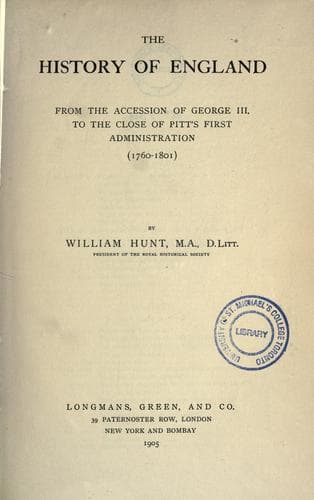
The history of England, from the accession of George III. to the close of Pitt's first administration, 1760-1801Hunt, William
History
The history of England, from the accession of George III. to the close of Pitt's first administration, 1760-1801
Hunt, William
Great Britain -- History -- George III, 1760-1820
Although parliament had not lasted its full term of seven years, it was
dissolved on September 30. The king was probably anxious that a new
parliament should be elected before any event took place which might
suggest doubt as to the success of his American policy. Besides, he was
anxious to secure more men of landed property as members, and reckoned
that a sudden dissolution would foil "the nabobs, planters, and other
volunteers," who would not be ready for the battle.[95] His design was
successful, and the election as a whole was marked by the predominance
of the country gentlemen, at that period the best element in a house of
commons. Much to George's annoyance the Grenville election act had been
made perpetual during the last session. Its good effects were apparent
in the election of 1774; it made the bribery of borough electors
dangerous, and there was far less of it than before. Bargains, however,
could still be made with the owners and patrons of boroughs, and the
king made himself responsible for the money North expended. North
offered Lord Falmouth L2,500 a piece for three Cornish seats and had "to
make it guineas". Other bargains of the same kind were made. George, who
was great at electioneering manoeuvres, took much interest in the
proceedings. He was unable to find a candidate to stand against Wilkes,
then lord mayor elect, and Wilkes and Glynn were returned for Middlesex
without opposition. Wilkes took his seat without encountering any
difficulties and his political importance virtually ended with his
exclusion. Bristol returned Burke, who was recommended to that great
commercial city by his desire for conciliation with America, and his
knowledge of mercantile affairs. At the declaration of the poll he dwelt
on the relations which should exist between a member and his
constituents: he should, he said, as their representative in all cases
prefer their interests to his own, but he should not sacrifice his
mature judgment to their opinion, or be subservient to their mandates.
As a whole the election satisfied the king, for the ministers had a
large and indeed an increased majority.
Public-domain text, read in full here on John Shaqi.
Reviews
Reviews
No reviews yet
Be the first to share your thoughts on this work.
Elsewhere in the archive
Join the Discussion
Join the discussion
Sign in to leave a comment or review.
Sign InorCreate an account