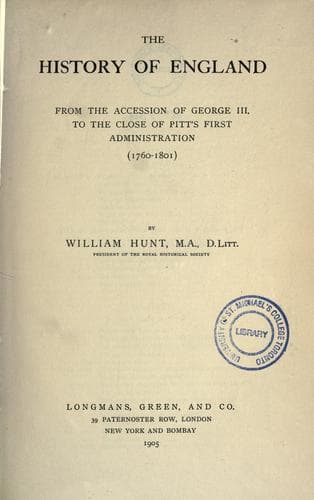
The history of England, from the accession of George III. to the close of Pitt's first administration, 1760-1801Hunt, William
History
The history of England, from the accession of George III. to the close of Pitt's first administration, 1760-1801
Hunt, William
Great Britain -- History -- George III, 1760-1820
to arrange terms of conciliation through Franklin.
[Sidenote: _CONCILIATORY RESOLUTIONS._]
On February 1 Chatham, who was in constant communication with Franklin,
brought in a conciliation bill. It was a strange composition, florid in
terms, embracing a multiplicity of subjects, and depending for its
operation on the good-will of the Americans. He proposed to assert the
supremacy of parliament, specially in matters of trade, to confine
taxation to the provincial assemblies, and to legalise the coming
congress in order that it might make a perpetual free grant to the
crown, which was to be appropriated by parliament to the reduction of
the national debt. Having obtained this grant, parliament was to reduce
the power of the admiralty courts, which checked illicit trading, and to
suspend all the acts, including the Quebec act, of which the Americans
complained. The bill was not allowed a second reading. Soon after its
ignominious rejection the gout laid hold on Chatham, and he did not
appear in parliament again for two years. Franklin returned to America
about this time; he disclaimed responsibility for Chatham's proposals,
which, he considered, would only have been useful as a basis for future
arrangement. North at last informed parliament of the threatening state
of affairs. Massachusetts was declared in rebellion; votes were passed
for 2,000 additional seamen and about 4,400 soldiers; it was resolved to
increase the force at Boston to 10,000 men; and a bill was passed
confining the commerce of the New England provinces to Great Britain
and the West Indies, and shutting them out from the Newfoundland
fishery. These restraints, which were evoked by the American
non-intercourse agreements, were soon extended to five other provinces.
Public-domain text, read in full here on John Shaqi.
Reviews
Reviews
No reviews yet
Be the first to share your thoughts on this work.
Elsewhere in the archive
Join the Discussion
Join the discussion
Sign in to leave a comment or review.
Sign InorCreate an account