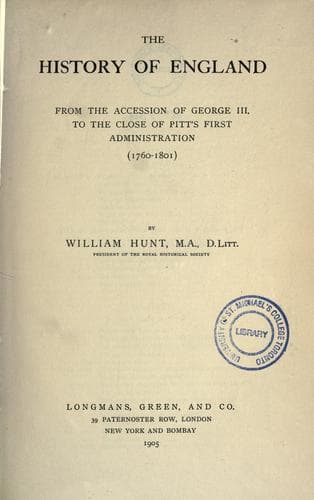
The history of England, from the accession of George III. to the close of Pitt's first administration, 1760-1801Hunt, William
History
The history of England, from the accession of George III. to the close of Pitt's first administration, 1760-1801
Hunt, William
Great Britain -- History -- George III, 1760-1820
While George promoted these strong measures, he willingly fell in with
North's desire to "hold out the olive-branch"; and on the 20th North
moved a resolution to the effect that if any colony provided what
parliament considered its fair proportion towards the common defence and
the expenses of its civil administration, no duty or tax should be
imposed upon it, except for the regulation of trade. His proposal
excited the indignation of the high prerogative party, who thought
themselves betrayed; his followers rose in revolt; "the treasury bench
seemed to totter". The storm was stilled at last, and then Barre, Burke,
and Dunning fell upon the bill, describing it as a mean attempt to
divide the Americans, and a plan for coercing each province separately.
The motion was, however, carried. As the opposition scorned North's
plan, which Burke called "a project of ransom by auction," it behoved
them to bring forward a plan of their own which would be acceptable to
the Americans. Accordingly, on March 22, Burke propounded a series of
conciliatory resolutions which he enforced in one of his most famous
speeches. He urged the house to return to its old policy, to respect the
Americans' love of freedom, to look to the colonial assemblies to supply
the expenses of their government and defence, to abandon the futile
attempt to impose taxation, and to extend to Americans the privileges of
Englishmen. His proposal was defeated. Nevertheless, by accepting
North's resolution parliament showed a desire for pacification. The
resolution proposed a compromise; while it maintained the authority of
parliament, it offered the Americans self-taxation. It was made with a
sincere desire to end the quarrel. At one time it might have led to
pacification, but it came too late.
Public-domain text, read in full here on John Shaqi.
Reviews
Reviews
No reviews yet
Be the first to share your thoughts on this work.
Elsewhere in the archive
Join the Discussion
Join the discussion
Sign in to leave a comment or review.
Sign InorCreate an account