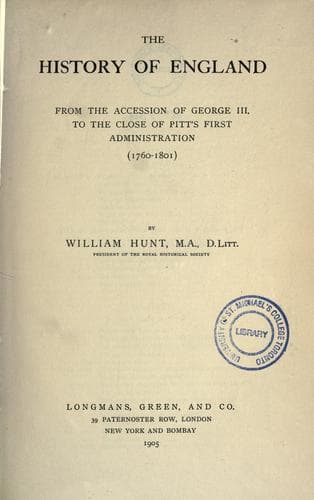
The history of England, from the accession of George III. to the close of Pitt's first administration, 1760-1801Hunt, William
History
The history of England, from the accession of George III. to the close of Pitt's first administration, 1760-1801
Hunt, William
Great Britain -- History -- George III, 1760-1820
The insurgents were not content with fighting on their own ground. The
command of the line of the Hudson would prevent the British from cutting
off New England from the middle colonies, would secure New York from
attack from the north, and would open a way for an invasion of Canada.
On the north the approaches to the river were dominated by the forts of
Ticonderoga and Crown Point, which had played a conspicuous part in the
great war with France; and in them were laid up some 200 cannon, small
arms, and other military stores. Important as these forts were, no
adequate garrisons were maintained in them. Benedict Arnold, the leader
of a band of volunteers from New Haven, Connecticut, a druggist and West
India trader, was informed of their defenceless condition, and made an
offer to the Massachusetts committee of safety to capture them. His
offer was accepted, and he was authorised to raise a force. The same
plan had been formed in Connecticut; and Ethan Allen, the leader of an
association in Vermont, was sent with his followers to carry it out.
Arnold met him on the march; he refused to yield the command, and Arnold
joined his force, which included a body of Indians. At dawn on May 10
they surprised the garrison of Ticonderoga, consisting of less than
fifty men, and compelled the governor to surrender without striking a
blow. A detachment from the force seized Crown Point, and a few days
later Arnold sailed down Lake Champlain and captured St. John's, which
was recovered by the British in the course of the summer and garrisoned.
[Sidenote: _OPINION IN ENGLAND._]
Public-domain text, read in full here on John Shaqi.
Reviews
Reviews
No reviews yet
Be the first to share your thoughts on this work.
Elsewhere in the archive
Join the Discussion
Join the discussion
Sign in to leave a comment or review.
Sign InorCreate an account