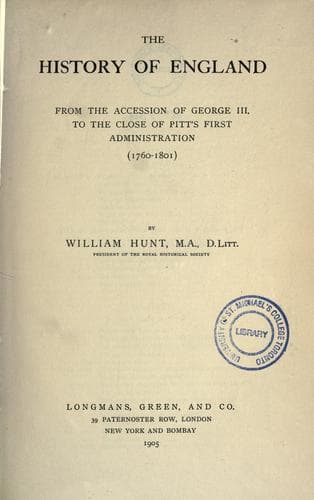
The history of England, from the accession of George III. to the close of Pitt's first administration, 1760-1801Hunt, William
History
The history of England, from the accession of George III. to the close of Pitt's first administration, 1760-1801
Hunt, William
Great Britain -- History -- George III, 1760-1820
of the sentiments and opinions of the colonists; the revolutionists
generally a turbulent, insolent, and unreasonable temper.
FOOTNOTES:
[89] Franklin, _Works_, v., 189-90, 205-7, 305-14, ed. Bigelow.
[90] _Chatham Corr._, iv. 339.
[91] _Parl. Hist._, xvii., 1197.
[92] Jones, _History of New York_, i., 34-35, 449, _sq._; Flick,
_Loyalism in New York_, pp. 24-25.
[93] Flick, _Loyalism in New York_, pp. 9-12.
[94] Sabine, _The American Loyalists_, pp. 51-55, 65.
[95] _Corr. with North_, i., 201.
[96] Burke to Flood, May 18, 1765, _Works_, i., 41.
[97] Dartmouth Papers, America, _Hist. MSS. Comm. Rep._, xiv., App. x.,
251.
[98] _The Border Warfare of the Revolution_, in _Narr. and Crit. Hist._,
vi., 612-14.
CHAPTER VIII.
THE COLONIAL REBELLION.
Scarcely had the night passed after the skirmish at Lexington before the
whole of Massachusetts was in arms. The provincial assembly voted that
an army of 30,000 men should be raised in New England, fixed on
Cambridge as its headquarters and sent to their neighbours for support.
From New Hampshire, Connecticut, and Rhode Island the answer was prompt.
Numerous bands of volunteers marched to join the forces of
Massachusetts, and an army of 16,000 men soon invested Boston from the
Mystic river to Roxbury. It was an army without unity, for the troops of
each colony acted under their own leaders; and its numbers varied from
day to day, the Massachusetts volunteers, who formed its principal part,
taking leave of absence whenever they chose. Many of the provincials had
seen service against the French, and understood a soldier's work, and
many more had received some training in the militia, but the mass of the
volunteers had no military experience or discipline. Yet they were men
well used to shoot and to handle the spade and axe, implements of
first-rate importance in war; they belonged as a whole to a higher class
than the privates of the British army, they were more resourceful and
intelligent, and were able to obtain provisions and other supplies
without difficulty. Such as they were, Gage judged them too formidable
in number for him to attack. The neck of land which joins Boston to the
continent had been fortified so strongly that the provincials could not
hope to storm it, and he decided to remain behind it and await the
arrival of the reinforcements which were already on their way. He made
no effort to prevent the insurgents from shutting up his army on the
landward side, and early in May they began to form entrenchments. At the
same time they took measures to distress the beleaguered force by
clearing off the live-stock, hay, and other supplies from the islands in
the harbour. Gage tried in vain to stop them, and there were several
skirmishes in the harbour, in which the British suffered more heavily
than the provincials.
Public-domain text, read in full here on John Shaqi.
Reviews
Reviews
No reviews yet
Be the first to share your thoughts on this work.
Elsewhere in the archive
Join the Discussion
Join the discussion
Sign in to leave a comment or review.
Sign InorCreate an account