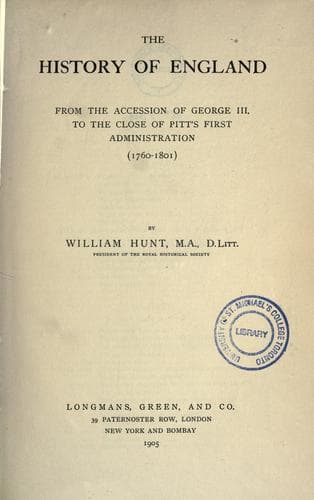
The history of England, from the accession of George III. to the close of Pitt's first administration, 1760-1801Hunt, William
History
The history of England, from the accession of George III. to the close of Pitt's first administration, 1760-1801
Hunt, William
Great Britain -- History -- George III, 1760-1820
In America the news of the affair at Lexington called forth in every
colony a spirit of union, a determination to stand by their New England
brethren. No answers were sent to North's conciliatory proposals; all
alike agreed in referring them to the continental congress. This was
equivalent to a rejection of them, for it was well known that the
British government would hold no communication with that body. The
congress met for the second time at Philadelphia on May 10. It rejected
North's proposals and agreed that garrisons should be maintained at
Ticonderoga and Crown Point, a decision which implied an approval of the
offensive war levied against the king in the expedition against those
forts. As, however, it was expedient to lull the suspicions of the
French Canadians, who were not likely to have forgotten the religious
bitterness exhibited by the Americans with reference to the Quebec act,
it declared that no invasion of Canada would be made. The congress
assumed executive powers; in the name of the "United Colonies" it
adopted the army of New England then before Boston as the continental
army, took measures for its organisation and payment, authorised a loan,
and on June 15 chose George Washington, the colonel of the Virginia
militia, as commander-in-chief.
No wiser choice could have been made. Washington was a gentleman of
Virginia, of independent fortune, descended from an English family of
good position; he had served with distinction against the French, and as
aide-de-camp to Braddock had behaved with remarkable intrepidity in the
battle on the Monongahela river in 1755. Thoroughly unselfish, he
devoted himself with all his heart to public duty; his integrity was
above suspicion; he was free from personal ambition, and was never
swayed by jealousy. His education had been neglected, but his intellect
was clear and his judgment sound. He was naturally hot-tempered, and
when his anger was roused he was a terror to evil-doers, to the officer
who disobeyed his orders and to the rascally contractor who supplied his
army with inferior stores. Yet he habitually kept his temper under
control. Steadfast in purpose, he was never overwhelmed by misfortune
and never yielded to factious opposition. And strong as his will was, it
did not degenerate into obstinacy; he would gladly listen to the advice
of others, and in military matters was sometimes too ready to act upon
it. At first he made mistakes in generalship, but his military skill
grew with his experience. In army administration he was excellent; his
industry was unwearying; the smallest details received his personal
attention. He was conscious of the difficulties of the task which lay
before him; he believed, so he told Patrick Henry, that from the day of
his appointment his reputation would begin to decline. The congress was
an unorganised body without any constitutional status, conducting its
business by means of constantly changing and irresponsible committees,
Public-domain text, read in full here on John Shaqi.
Reviews
Reviews
No reviews yet
Be the first to share your thoughts on this work.
Elsewhere in the archive
Join the Discussion
Join the discussion
Sign in to leave a comment or review.
Sign InorCreate an account