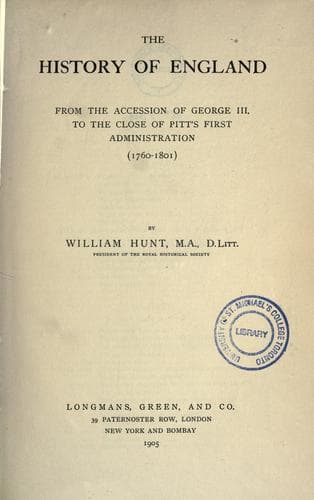
The history of England, from the accession of George III. to the close of Pitt's first administration, 1760-1801Hunt, William
History
The history of England, from the accession of George III. to the close of Pitt's first administration, 1760-1801
Hunt, William
Great Britain -- History -- George III, 1760-1820
and was utterly unfit to exercise executive functions; it had no means
of enforcing its decrees, no revenue, and no munitions of war. The army
which it adopted was little better than an assembly of armed men; many
were volunteers, and it was decided to enlist men only for seven months.
There was little discipline; the officers were for the most part
ignorant of their duties and were of the same social standing as their
men; and the New England privates, self-opiniated and obstinate, showed
little respect for their orders. Washington had not merely to command an
army in the field, he had to create one and, what was harder still, to
keep it together.
[Sidenote: _THE SIEGE OF BOSTON._]
Inside Boston life was by no means pleasant. All marketing from the
country was at an end, for the town was closely beset by land and the
islands were cleared of provisions; no fresh meat was to be had, and the
besieged lived alternately on salt beef and salt pork. Attacks from
fire-rafts and whale-boats were daily threatened, and fears were
entertained that the inhabitants might set fire to the town in order to
force the British to leave it.[101] On May 25 the three new generals
landed, and the arrival of the reinforcements raised the number of
Gage's army to about 10,000 men. Believing that the rebellion would soon
be quelled, he issued a foolish proclamation, offering pardon to all
rebels who laid down their arms, except Samuel Adams and Hancock, then
president of the congress, and threatening those who continued in arms
with punishment as traitors. As the insurgents had no ships, while the
British had floating batteries and ships of war in the harbour, they
could not hope to destroy Gage's army, or reduce it to surrender through
famine. Their object was to compel him to evacuate the place and sail
off. The peninsula on which the town stands was commanded by hills both
on the north and south-east. On the north were the hills of the
Charlestown peninsula, which was separated from Boston by the Charles
river; it had the Mystic river on its northern side, and was joined to
the mainland by a narrow neck. On the south-east it was commanded by the
hills of another peninsula called Dorchester Neck. A battery on either
the Charlestown hills or the Dorchester heights would have rendered
Gage's position untenable; for, independently of any loss which his
troops might sustain from bombardment, the British shipping would be
drawn from its anchorage, and if he remained he would be practically
imprisoned in the town and cut off from supplies. It should therefore
have been Gage's first care to shut the insurgents out from those
positions.
Public-domain text, read in full here on John Shaqi.
Reviews
Reviews
No reviews yet
Be the first to share your thoughts on this work.
Elsewhere in the archive
Join the Discussion
Join the discussion
Sign in to leave a comment or review.
Sign InorCreate an account