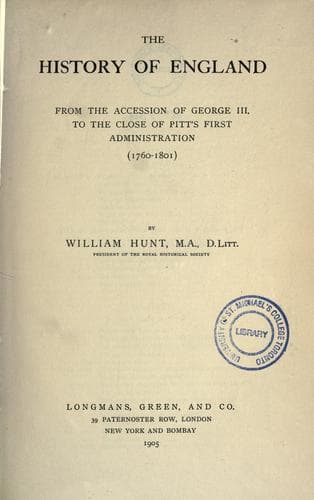
The history of England, from the accession of George III. to the close of Pitt's first administration, 1760-1801Hunt, William
History
The history of England, from the accession of George III. to the close of Pitt's first administration, 1760-1801
Hunt, William
Great Britain -- History -- George III, 1760-1820
The progress of the revolt during the summer of 1775 strengthened the
king's determination to subdue it by force. A proclamation was issued in
August against traitorous correspondence with the Americans, and in
September Penn, who brought over the petition of congress to the king,
was informed that no answer would be made to it. George could not have
received it without recognising congress, an unauthorised assemblage of
his subjects engaged in levying war against him. The government was
powerful in parliament, and the great majority of the nation warmly
approved the royal policy, of which the ministers were scarcely more
than the agents. Little doubt was felt as to the successful issue of the
war; public spirit was aroused, and the cause of England was generally
held to be just. The landed gentry and the professions of the Church,
the army, and the law were strongly on the king's side. Self-interest
largely decided the attitude of the mercantile class: some of its
members were opposed to the war because it injured their trade; others
were in favour of it; for trade generally was brisk and was increased by
the demands brought by war. In London and Bristol the opposition had
many supporters, but in both cities there was a strong party in favour
of the government. Among the labouring classes the war was not popular
and recruiting was difficult, for service in America entailed a long
voyage full of discomfort, and the prospect of fighting with men of the
same race and language was repellent. The evangelicals and methodists
sided with the government; the dissenters generally were against the war
and their preachers were active in encouraging their dislike to it.
Addresses approving of the king's policy were numerous and unsolicited;
they poured in from all quarters, from tory Oxford and whiggish
Cambridge, from country towns and great commercial centres like
Liverpool and Manchester. Rockingham observed that violent measures were
countenanced by a majority of persons "of all ranks, professions, or
occupations in this country". Scotland almost to a man was of the same
persuasion. In Ireland the nobles and the gentry generally upheld the
court, but with the majority of protestants, and specially with the
presbyterians of the north, the war was highly unpopular.[108]
[Sidenote: _CHANGES IN THE MINISTRY._]
Public-domain text, read in full here on John Shaqi.
Reviews
Reviews
No reviews yet
Be the first to share your thoughts on this work.
Elsewhere in the archive
Join the Discussion
Join the discussion
Sign in to leave a comment or review.
Sign InorCreate an account