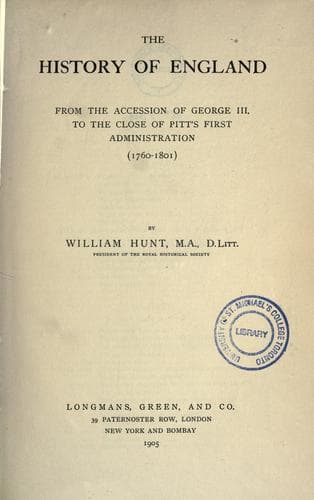
The history of England, from the accession of George III. to the close of Pitt's first administration, 1760-1801Hunt, William
History
The history of England, from the accession of George III. to the close of Pitt's first administration, 1760-1801
Hunt, William
Great Britain -- History -- George III, 1760-1820
The opponents of the government were not less resolute than the king.
Lord Effingham resigned his commission in the army lest he should be
called upon to serve against the Americans, and Chatham's eldest son
took the same course in obedience to the wishes of his parents. Grafton
wrote to North in August, 1775, expressing his desire for conciliation.
On October 20 North sent him a draft of the king's speech which showed
him that the government was determined to reduce the rebellion by force
of arms. He resigned the privy seal and went into opposition. The
changes which followed proved that a vigorous policy would be carried
out. Dartmouth took Grafton's place and was succeeded as secretary of
state for the colonies by Lord George Germain, previously known as Lord
George Sackville. Germain was at this time one of North's followers, and
was appointed in order that he might help him in the commons. Violent in
his feelings against the Americans, he was acceptable to the king and
acquired influence over him. His appointment was unpopular. He had fair
ability, but as minister allowed himself to be swayed by personal
motives, and he pursued a system already adopted by the king of
directing military operations in America from London which had
disastrous consequences. Rochford retired with a pension of L2,500 and
was succeeded by Weymouth as secretary of the southern department.
The king's speech at the opening of parliament on October 26, 1775,
stated that the Americans were in rebellion and were seeking to
"establish an independent empire". Eight months had yet to pass before
the colonies declared their independence, and the effect of events which
hastened their decision, such as the employment of German troops and the
refusal to answer the petition of congress, was not yet known in
England. It will, however, scarcely be denied that between the
proceedings of congress and a formal declaration of independence the
distance was not great. The strength of the king's position lay in his
recognition of this fact and of the course which alone might have
quelled the growing spirit of rebellion without humiliation to Great
Britain. The opposition did not see facts as they really were, and
called for remedies which were either vague, of various import,
insufficient, or such as would have placed the crown in a humiliating
position. In the lords' debate on the address, Rockingham urged a vague
undertaking to adopt measures of conciliation, Grafton the repeal of the
acts relating to America since 1763, and Shelburne that the petition of
congress proved that the colonies were not "planning independence". In
the commons Burke taunted the ministers with failure; and Fox, who was
coming to the front, praised the spirit of the Americans, denied that
they were aiming at independence, and bitterly attacked North, who, said
he, had lost more in one campaign than Chatham, Frederick of Prussia, or
Alexander the Great had ever gained--he had lost a whole continent. The
Public-domain text, read in full here on John Shaqi.
Reviews
Reviews
No reviews yet
Be the first to share your thoughts on this work.
Elsewhere in the archive
Join the Discussion
Join the discussion
Sign in to leave a comment or review.
Sign InorCreate an account