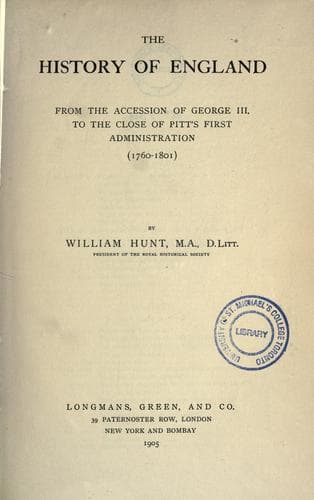
The history of England, from the accession of George III. to the close of Pitt's first administration, 1760-1801Hunt, William
History
The history of England, from the accession of George III. to the close of Pitt's first administration, 1760-1801
Hunt, William
Great Britain -- History -- George III, 1760-1820
address was carried in the lords by 76 to 33, and in the commons by 176
to 72.
Motions were made in both houses declaring that the employment of
Hanoverian troops within the king's dominions, at Gibraltar and Minorca,
without previous consent of parliament was unconstitutional. It was, the
opposition maintained, a violation of the bill of rights, which declared
that "the keeping a standing army within the kingdom in time of peace,
unless it be with consent of parliament, is against law". On the
government side it was pointed out that it was not a time of peace and
that the clause did not apply to the dependencies of the kingdom. North,
however, consented to a bill of indemnity which was thrown out by the
lords, the opposition objecting to it on the ground that it asserted the
legality of the measure, the government that it was totally unnecessary.
Numerically weak as the opposition was, it maintained the fight with
spirit. Motions more or less directly aimed at the war policy of the
government were made in the lords by Grafton and Richmond, and in the
commons by Luttrell, Fox, Burke, Oliver, Hartley, Lowther, and
Sawbridge. On none of these did the minority vote stronger than 33 in
the lords and 105 in the commons. Burke, in bringing in a bill on
November 16 for composing the troubles in America, urged that the right
way was by concessions to be followed by treaty. He would maintain the
declaratory act of 1766 as necessary to the authority of parliament, and
certain acts passed since 1763 as necessary to British trade; and he
desired that parliament should enact that no tax should be levied on
the colonies other than by their voluntary grant, and should repeal
coercive acts such as that closing Boston harbour. These concessions,
while greater than the government would make, would not, it was pointed
out, have satisfied the Americans; they did not go to the root of
American discontent, which lay in the revenue laws, and dated not from
the year 1766, but reached back to 1672. After a long debate, of which
we have virtually no record, for strangers were excluded from the house,
the bill was lost by 210 votes to 105.
[Sidenote: _THE STATE OF THE NAVY._]
Public-domain text, read in full here on John Shaqi.
Reviews
Reviews
No reviews yet
Be the first to share your thoughts on this work.
Elsewhere in the archive
Join the Discussion
Join the discussion
Sign in to leave a comment or review.
Sign InorCreate an account