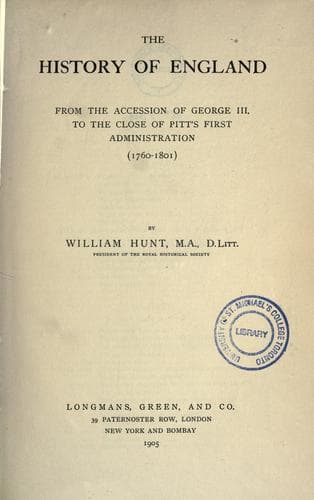
The history of England, from the accession of George III. to the close of Pitt's first administration, 1760-1801Hunt, William
History
The history of England, from the accession of George III. to the close of Pitt's first administration, 1760-1801
Hunt, William
Great Britain -- History -- George III, 1760-1820
[104] Gage to Dartmouth, June 25, 1775, _Dartmouth Papers_, ii., 320.
[105] Codman, _Arnold's Expedition to Quebec_, pp. 22-25, 141.
[106] Fonblanque, _Burgoyne_, p. 195; _Dartmouth Papers_, ii., 357.
[107] The King to North, July 28, 1775, _Correspondence with North_, i.,
256.
[108] On national feeling generally see _Annual Reg._, xix. (1776),
38-39; Burke to Champion, Jan. 10, 1775, and Rockingham to Burke, Sept.
24, _Burke's Works_, i., 259 _sq._, 291-92; Lecky, _History_, iii.,
528-34.
[109] Barrow, _Life of Anson_, pp. 214-16.
[110] Progress of the Navy, MS. Admiralty, Miscell., 567, R.O.
[111] George to North, April 13, 1776, _Corr. with North_, ii., 18.
CHAPTER IX.
SARATOGA.
On June 11, 1776, Howe sailed from Halifax with his army of 9,000 men,
and on July 3 occupied Staten Island without opposition. There he was
joined by the reinforcements from England, conveyed by Lord Howe, and by
Clinton and his troops, so that in August he had with him some 25,000
men, English and German. Washington's army at New York numbered about
19,000 effectives.[112] Mindful of his commission to restore
tranquillity, Lord Howe wrote to him enclosing a copy of the king's
offers. Washington would not receive the letter because the address did
not acknowledge his military rank, and observed that the powers of the
commissioners extended only to granting pardons, and that his people had
done nothing for which they needed pardon. The pacific mission of the
Howes having so far failed, the general on August 22-25 landed an army
on Long Island, which is separated from New York by the East river.
Brooklyn heights on Long Island, opposite New York, were strongly
fortified and held by the Americans. Washington, believing that a larger
British force was left in Staten Island than was really the case,
thought it necessary to keep a numerous garrison in New York to meet a
direct attack on the place, and detached only some 9,000 men under
Putnam to Long Island. They were for the most part posted so as to hold
a belt of wooded hills lying between their lines and the royal army.
During the night of the 26th Howe outflanked them and brought his main
body to a position on their rear. The next day an attack was made on
their front; they were caught between two divisions of the king's troops
and were defeated. Howe put their loss at 3,300, which is certainly an
overestimate, though he made nearly 1,100 prisoners, among them the
generals Sullivan and Lord Stirling, as the Americans called him, an
unsuccessful claimant of that earldom.[113] The British casualties were
377. The Americans retreated within their inner lines. If Howe had
allowed his troops to storm their entrenchments he would probably have
destroyed or taken the whole force on the island. He considered,
however, that the lines could in a few days be taken "at a very cheap
rate" by regular approaches, and decided not to risk the loss of any
Public-domain text, read in full here on John Shaqi.
Reviews
Reviews
No reviews yet
Be the first to share your thoughts on this work.
Elsewhere in the archive
Join the Discussion
Join the discussion
Sign in to leave a comment or review.
Sign InorCreate an account