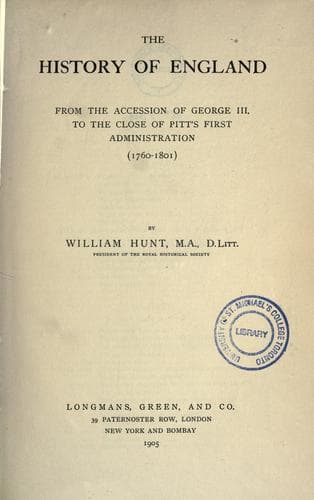
The history of England, from the accession of George III. to the close of Pitt's first administration, 1760-1801Hunt, William
History
The history of England, from the accession of George III. to the close of Pitt's first administration, 1760-1801
Hunt, William
Great Britain -- History -- George III, 1760-1820
more men.[114] He let his opportunity slip, and on the night of the 29th
Washington, helped by a fog, cleverly withdrew his troops across the
river.
[Sidenote: _NEW YORK TAKEN._]
Lord Howe took advantage of the American defeat to invite congress to
send some of its members to confer with him unofficially as to possible
terms of peace. Congress, though it refused to sanction any unofficial
negotiations, sent commissioners from its own body to confer with him.
Nothing came of the conference, for the American commissioners would not
treat except on the basis of independence. On September 15 the British
army descended on Manhattan Island, on which New York stands, and the
American militia fled in disorder. The British took possession of New
York and of sixty-six of the enemy's guns. If Howe's movements had been
more prompt he might have cut off a large number of the enemy; he is
said to have wasted time by lingering over luncheon at the house of the
mother of Lindley Murray, the grammar-writer, who detained him by her
crafty hospitality. Washington drew off his troops to Haarlem heights,
in the northern part of the island. The next day there was some
skirmishing in which the Americans held their ground. The loyalists of
New York had been shamefully treated by the dominant faction, and the
British were received with joy.[115] A few days later a large part of
the city was destroyed by fires evidently kindled by incendiaries.
Washington and other generals had wished for military reasons to burn
the place. They were prevented by congress, but the idea was taken up
by some violent revolutionists. The Americans were disheartened by their
ill-success; Washington's troops deserted in large numbers, and the
greatest disorder prevailed in his army. In England the news of Howe's
victory and his occupation of New York was received with delight, and
the king rewarded him with the Order of the Bath.
Public-domain text, read in full here on John Shaqi.
Reviews
Reviews
No reviews yet
Be the first to share your thoughts on this work.
Elsewhere in the archive
Join the Discussion
Join the discussion
Sign in to leave a comment or review.
Sign InorCreate an account