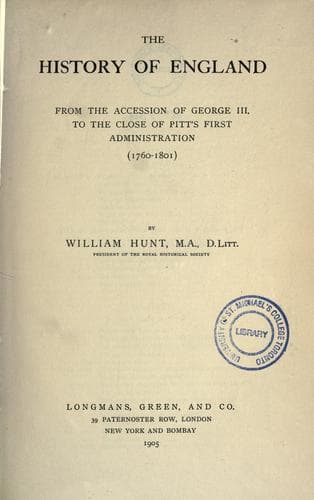
The history of England, from the accession of George III. to the close of Pitt's first administration, 1760-1801Hunt, William
History
The history of England, from the accession of George III. to the close of Pitt's first administration, 1760-1801
Hunt, William
Great Britain -- History -- George III, 1760-1820
While war was thus increasing the burden of the nation, the king again
applied to parliament for payment of the arrears of the civil list,
amounting to L618,000. The ministers exhibited accounts which failed to
satisfy the opposition. Wilkes pointed out that payments since 1769 of
L171,000 and L114,000 for secret service were each noted in a single
line, and that there was a general charge of L438,000 for pensions. As
in 1769, the arrears must be traced to an expenditure which increased
the king's influence. Wilkes said this plainly, Burke in less broad
terms, and Fox taunted North with the pledge given when he was in office
in 1769 that no such demand should be made again. Besides money
deliberately spent in corruption, vast sums were wasted on abuses in the
royal household, on sinecures, and on other useless places of profit.
One of the king's turnspits was a member of the house of commons, and
paid L5 a year to a humble deputy, and no fewer than twenty-three
separate tables were kept up, eleven for the nurses. For such abuses
George was only partially responsible. Though he lived with a frugality
which was almost meanness, he was in dire distress for money; the wages
of his menial servants were six quarters in arrear, and he owed his
coal-merchant L6,000.[120] After much discussion the money was voted,
and the civil list was increased to L900,000 a year. In presenting the
bill to the king the speaker, Sir Fletcher Norton, dwelt on the
magnificence of the gift, and added that the commons were confident that
he would apply wisely what they had granted liberally. Though the court
party in the commons declared that he had not expressed the feeling of
the house, he received a vote of thanks for his speech. Towards the
close of the session Chatham was sufficiently recovered from his long
illness again to attend parliament, and moved an address to the crown to
put an end to the war. He pointed out the danger of foreign
intervention, and declared that France was already destroying our
commerce. The idea of conquering America was absurd; America would not
be conquered by the loss of ten pitched battles. He was against American
independence, but this country, he said, was the aggressor, and "instead
of exacting unconditional submission from the colonies, we should grant
them unconditional redress". His motion was negatived by 99 votes to 28.
[Sidenote: _THE PLAN OF CAMPAIGN._]
Public-domain text, read in full here on John Shaqi.
Reviews
Reviews
No reviews yet
Be the first to share your thoughts on this work.
Elsewhere in the archive
Join the Discussion
Join the discussion
Sign in to leave a comment or review.
Sign InorCreate an account