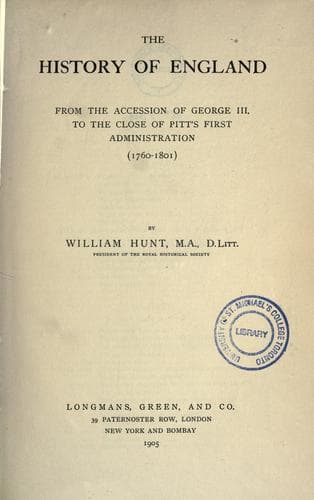
The history of England, from the accession of George III. to the close of Pitt's first administration, 1760-1801Hunt, William
History
The history of England, from the accession of George III. to the close of Pitt's first administration, 1760-1801
Hunt, William
Great Britain -- History -- George III, 1760-1820
A fresh plan for obtaining the mastery of the line of the Hudson was
already in course of preparation. Burgoyne, who returned home in
December, obtained the command of the northern army, and, on February
28, laid a project of campaign before the government. He proposed to
secure Ticonderoga and the lakes, and march down the Hudson to Albany,
where he was to effect a junction with Howe, previously detaching a
small force to create a diversion by advancing from Oswego and down the
Mohawk river to Albany. The object of this plan was to open
communication between New York and Canada, cut off New England from the
southern provinces, and enable Howe to operate in the south with an
overwhelming force. He pointed out the difficulties of the proposed
march and suggested alternative schemes; but his first project was
chosen by the king, and he was ordered to carry it out. The projected
campaign, if successful, would have been disastrous to the Americans.
Its success depended on Howe's co-operation. An invasion by distinct
armies, such as Burgoyne proposed, with bases far apart and acting on
converging lines, can only be undertaken with safety when
intercommunication is secure and co-operation assured. Otherwise one of
the invading armies is liable to be crushed before it can receive help
from another, specially when, as was the case here, the enemy can act on
lines interior to those on which the invaders move. Burgoyne fell into
the error, common throughout the war, of trusting too much to loyalist
help. Apart from that, however, his project assumed that Howe would be
advancing up the Hudson in time to get between him and any large force
which might advance against him, and it failed miserably, because Howe
did not co-operate with him. Germain informed Carleton of the plan and
ordered him to resign the command of the northern army to Burgoyne; he
was to command only within his own province, keeping 3,700 men with him,
and was to forward Burgoyne's expedition. Germain reproached him for his
retirement from Ticonderoga, which, he said, gave Washington the means
of breaking the British line at Trenton. Carleton was indignant at this
unworthy treatment, and though he did what he could to help Burgoyne, he
resigned the governor-generalship.[121]
Public-domain text, read in full here on John Shaqi.
Reviews
Reviews
No reviews yet
Be the first to share your thoughts on this work.
Elsewhere in the archive
Join the Discussion
Join the discussion
Sign in to leave a comment or review.
Sign InorCreate an account