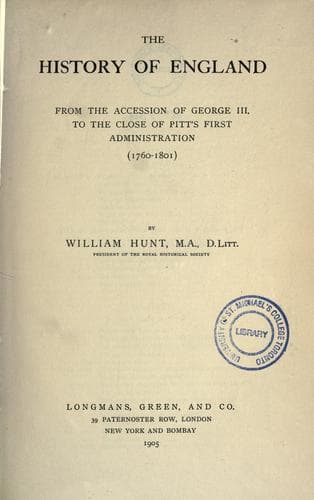
The history of England, from the accession of George III. to the close of Pitt's first administration, 1760-1801Hunt, William
History
The history of England, from the accession of George III. to the close of Pitt's first administration, 1760-1801
Hunt, William
Great Britain -- History -- George III, 1760-1820
In order to secure communication with New York and to supply the army,
it was all-important that the fleet should be able to pass up the
Delaware, which was strongly defended by forts, a bar, and a fleet of
little vessels; and Howe detached troops to act against the forts.
Washington lay a few miles to the north; he was joined by strong
reinforcements, and determined to take advantage of the division of the
British troops. He formed a plan for surprising and driving in their
advanced posts, cutting their force in two, crushing their right wing,
and then doubling the whole army back on the Schuylkill river where it
would be at his mercy. He attacked at daybreak on October 4 under cover
of a fog. The head of the British position was insufficiently guarded
and the 40th regiment was driven back. At this critical moment its
commander, Musgrave, and a party of his men stopped the enemy's advance
by seizing a house which stood in their way and holding it against them
until the army had time to form. His gallant conduct saved the army. The
Americans fought well until, misled by the fog, one of their brigades
fired on another. This threw them into disorder, which was increased by
the drunkenness of some of their officers and men. Cornwallis came up
from Philadelphia in hot haste and pressed upon them. They retreated
with a loss of 673 killed and wounded, and 400 taken; on the British
side the casualties were 551. Both in this action and in the battle on
the Brandywine the Americans showed that they had learned to fight with
resolution and to retreat in good order. The two engagements proved that
though they might be defeated in the field, the war would not come to a
speedy end, and this enlisted foreign sympathy and encouraged France to
intervene on their side.
For a month Howe was engaged in opening the passage of the Delaware. He
sent for 4,000 men from New York. This reduction of the garrison was
most unfortunate, for, as we shall see, it put an end to Clinton's
attempt to co-operate with Burgoyne.[123] At last the defences of the
river were destroyed, and communication was established between the army
and the fleet. Washington retreated to Valley Forge, about twenty-five
miles from Philadelphia, and there put his army into quarters. During
the winter his troops suffered terribly from lack of clothing and
provisions. By Christmas nearly 3,000 were unfit for duty because they
were "barefoot or otherwise naked". They deserted in parties, a large
number came to the British quarters, and scarcely a day passed without
the resignation of an officer. In February, 1778, there was almost a
famine in the camp, and Washington feared a general mutiny and
dispersion.[124]
Public-domain text, read in full here on John Shaqi.
Reviews
Reviews
No reviews yet
Be the first to share your thoughts on this work.
Elsewhere in the archive
Join the Discussion
Join the discussion
Sign in to leave a comment or review.
Sign InorCreate an account