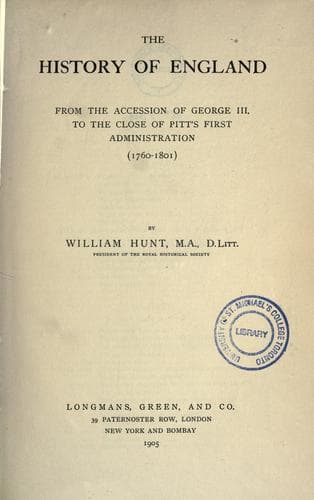
The history of England, from the accession of George III. to the close of Pitt's first administration, 1760-1801Hunt, William
History
The history of England, from the accession of George III. to the close of Pitt's first administration, 1760-1801
Hunt, William
Great Britain -- History -- George III, 1760-1820
During the winter Howe formed a plan for taking Philadelphia, and on
December 20, 1776, expounded it by letter to Germain, observing that the
northern army would not reach Albany before September. Germain wrote on
March 8 approving of his plan,[122] which might have been executed
without preventing the junction contemplated by the minister. After some
unimportant operations Howe took the field in June, and on the 5th
received a copy of Carleton's instructions relating to Burgoyne's
campaign. Washington's difficulties were then somewhat relieved; he
encamped at Middlebrook in a position too strong to be forced; he would
not be enticed to a general engagement, and Howe could not leave him in
his rear and push on to Philadelphia. Time was passing, yet Howe was
still set on prosecuting his design on Philadelphia. Finally he
embarked an army of 14,000 men at Sandy Hook, and instead of remaining
to be in readiness to co-operate with Burgoyne, left Clinton with 8,500
men to garrison New York and "act as circumstances may direct," and on
July 23 sailed for the Delaware, where he considered he would be
sufficiently near to New York to act with Burgoyne, if necessary, and
yet could carry out his own main design. The naval officers were
unwilling to risk disembarkation in the Delaware, and Howe, determined
not to give up his design, sailed for Chesapeake bay. The fleet met with
contrary winds, and it was not until August 25 that his army landed at
the head of Elk river. Washington with about an equal force marched to
the north of the Brandywine to defend Philadelphia. The two armies met
on September 11. Howe, who well knew how to handle an army in the field,
out-manoeuvred him, and after some sharp fighting the American army
was defeated with a loss of over 1,400 men, killed, wounded, and taken,
and eleven guns. Congress again decamped, and on the 27th Cornwallis
took possession of Philadelphia amid the acclamations of a large part of
the inhabitants, while Howe and the main army encamped at Germantown,
five miles to the north.
[Sidenote: _HOWE'S OBJECT ATTAINED._]
Public-domain text, read in full here on John Shaqi.
Reviews
Reviews
No reviews yet
Be the first to share your thoughts on this work.
Elsewhere in the archive
Join the Discussion
Join the discussion
Sign in to leave a comment or review.
Sign InorCreate an account