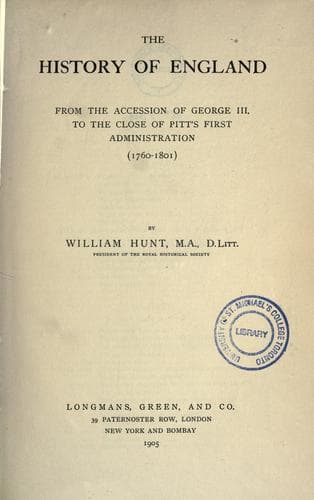
The history of England, from the accession of George III. to the close of Pitt's first administration, 1760-1801Hunt, William
History
The history of England, from the accession of George III. to the close of Pitt's first administration, 1760-1801
Hunt, William
Great Britain -- History -- George III, 1760-1820
Miss McCrae by an Indian who, it is said, was sent by her betrothed to
bring her into the British lines, excited widespread indignation.
Burgoyne was in sore need of supplies and made an attempt to seize the
insurgents' stores and horses collected at Bennington. He sent only some
500 men on this service, for he was assured that the district was
friendly. It was far otherwise. The party was surrounded on August 16,
and another detachment formed of German troops which was despatched to
help them marched so slowly that it did not come up in time. Both bodies
were defeated with a loss, perhaps, of about 500 men.
News came of the failure of St. Leger's expedition. On his arrival at
Oswego he was joined by Sir John Johnson and Butler with their loyalist
regiments, and by a force of Indians whom Johnson, one of their
superintendents, and the Mohawk leader, Brant, persuaded to march with
them. He besieged Fort Stanwix, and, on August 6, defeated a force sent
to relieve it. But his guns were too light for siege operations; the
garrison held out, and his Indians forced him to raise the siege. During
his retreat they mutinied; he was barely able to bring off his regular
troops, and lost his guns and stores. Burgoyne was in a dangerous
position; the country swarmed with enemies; "wherever the king's troops
point," he wrote, "militia to the number of three or four thousand
assemble in a few hours". He might have retreated to Fort Edward, where
he would have had communication with Lake George; but he held that he
was bound by his orders to advance, and on September 15, after
collecting provisions for about a month, he conveyed his force to the
western bank of the Hudson and cut himself off from communication with
the lakes. Besides artillery, he had then with him only 5,000 men under
arms.[126] On the 19th his force was partially engaged by Arnold at
Freeman's Farm. The British held their ground but lost over 500 men, and
Gates, the American commander, with 11,000 men, who did not take part in
the fight, occupied a strong position in front of them. A message came
from Clinton that he was about to attack the forts on the Hudson below
Albany, and Burgoyne sent answer that he hoped to be able to hold his
ground until October 20. He fortified his position and waited for
further news. None came to him. The insurgent forces grew to at least
16,000 men; Burgoyne's provisions were becoming exhausted and on October
3 he put his little army on half rations. Despite the overwhelming
number of the enemy, he moved forward on the 7th to ascertain whether he
could force a passage through their lines. He was defeated with heavy
loss and fell back on Saratoga.
[Sidenote: _SURRENDER OF BURGOYNE'S ARMY._]
Public-domain text, read in full here on John Shaqi.
Reviews
Reviews
No reviews yet
Be the first to share your thoughts on this work.
Elsewhere in the archive
Join the Discussion
Join the discussion
Sign in to leave a comment or review.
Sign InorCreate an account