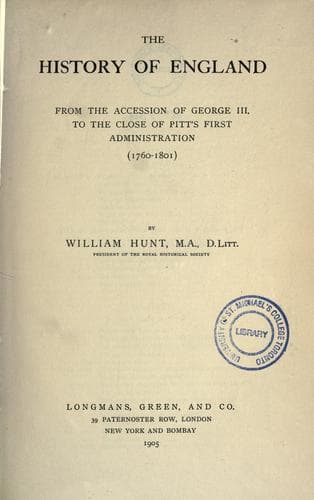
The history of England, from the accession of George III. to the close of Pitt's first administration, 1760-1801Hunt, William
History
The history of England, from the accession of George III. to the close of Pitt's first administration, 1760-1801
Hunt, William
Great Britain -- History -- George III, 1760-1820
A council of war held on the 12th decided on a retreat to Fort Edward.
It was too late; the Americans held the fords and had a strong force
encamped between Fort George and Fort Edward. Only 3,500 fighting men
were left with Burgoyne; he was completely surrounded, and on the 14th
he opened negotiations with Gates. Even then he refused to surrender
unconditionally, and the convention of Saratoga was concluded on the
17th. His troops marched out with the honours of war, and were to be
allowed to return to England on condition of not serving again in the
war. The whole number which surrendered, including camp-followers,
labourers, and detachments, was 5,762. Gates's behaviour at the
surrender was such as became an officer and a gentleman. Congress
shamefully broke the engagement. The captive troops were marched to
Boston, but when the transports called for them, they were not allowed
to embark. The paltry subterfuges by which congress defended its conduct
only throw a specially odious light on its sacrifice of honour to
policy. From the beginning of the war both sides made frequent
complaints as to the treatment of prisoners, and both apparently with
justice. Burgoyne's men were shamefully treated. He and his staff were
allowed to return home in the spring of 1778; others were exchanged from
time to time, but the mass of the army never came back. Clinton, who was
then unaware of Burgoyne's distress, did what he could to render his
position secure in case he arrived at Albany. As soon as he received
reinforcements from England, he pushed up the Hudson and on October 6
destroyed the forts which barred the passage of our ships. He could do
no more, for he was forced to send 4,000 men to Howe and could not leave
New York without a sufficient garrison. A messenger from Burgoyne at
last reached him. The way being cleared, the ships ascended the river
and burnt the batteries and town at Esopus creek. The news of Clinton's
activity doubtless secured Burgoyne more favourable terms than Gates was
at first inclined to grant.
Public-domain text, read in full here on John Shaqi.
Reviews
Reviews
No reviews yet
Be the first to share your thoughts on this work.
Elsewhere in the archive
Join the Discussion
Join the discussion
Sign in to leave a comment or review.
Sign InorCreate an account