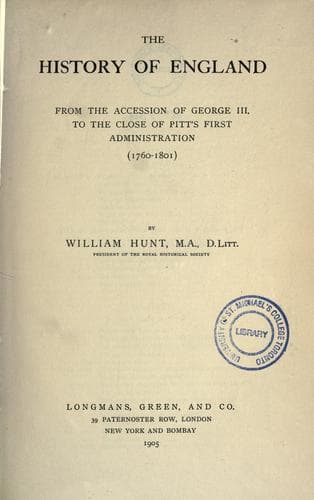
The history of England, from the accession of George III. to the close of Pitt's first administration, 1760-1801Hunt, William
History
The history of England, from the accession of George III. to the close of Pitt's first administration, 1760-1801
Hunt, William
Great Britain -- History -- George III, 1760-1820
When the Franco-American alliance was announced, North was urging the
king to invite Chatham to take office and to allow him to retire, and
Shelburne was sounded as to the terms on which Chatham would come in. He
replied that he would insist on "an entire new cabinet". George, who had
unwillingly agreed to this negotiation, was prepared to accept any men
of talent with a view of strengthening the existing ministry, but not of
forming another in its place, or of changing its measures. He would not
commission Chatham or any opposition leader to form a new ministry: "no
advantage to this country nor personal danger to himself" would, he
wrote to North, induce him to do so; he would rather "lose his crown".
"No consideration in life," he wrote again, "shall make me stoop to the
opposition;" he would not give himself up "to bondage". His
determination has been pronounced equally criminal with the acts which
brought Charles I. to the scaffold.[137] According to our present ideas
he should certainly have been guided by the assurance of his first
minister that the government was unequal to the situation, have
accepted his resignation, and allowed his new ministers to act as they
thought best. These duties, however, were not, as we have seen, so
clearly settled in those days. The prime minister of our time was not
then fully invented, and George's plan of personal government through
ministers was not yet rejected by the country. He could still rely on
the support of parliament. A proposal to request the king to dismiss his
ministers was defeated at that very time by 263 to 113 in the commons
and by 100 to 36 in the lords. Chatham's return to office would
doubtless have been hailed with satisfaction by the nation. Yet, though
a change in public sentiment with regard to the American war was
beginning, and was soon to spread rapidly, the king's policy was still
popular with the larger part of his subjects.[138] When therefore his
conduct in March, 1778, is compared with that of Charles I. it should be
remembered that George had parliament and the mass of the nation at his
back.
Public-domain text, read in full here on John Shaqi.
Reviews
Reviews
No reviews yet
Be the first to share your thoughts on this work.
Elsewhere in the archive
Join the Discussion
Join the discussion
Sign in to leave a comment or review.
Sign InorCreate an account