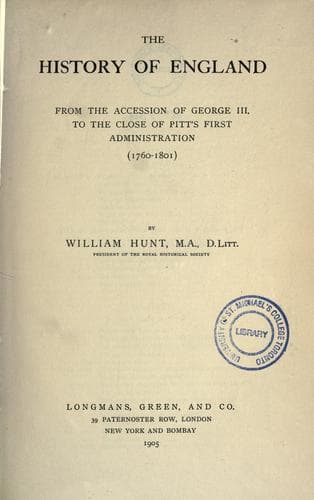
The history of England, from the accession of George III. to the close of Pitt's first administration, 1760-1801Hunt, William
History
The history of England, from the accession of George III. to the close of Pitt's first administration, 1760-1801
Hunt, William
Great Britain -- History -- George III, 1760-1820
The personal light in which he regarded the question is inexcusable. He
had been disappointed and deeply offended by Chatham's political
conduct, and he had cause to fear that a whig government would rob him
of the power which he loved. As a king he had no right to allow his
private feelings to affect his public action. That he did so was the
result partly of his system of personal rule, partly of serious defects
in his character, his implacability of temper, and his habit of
regarding all things as they affected himself. North struggled in vain
against his determination, and gave way before it. It is a mistake,
however, to regard the king as solely responsible for the continuance of
the war. If he is to be blamed because, rather than submit to the loss
of the colonies, which nearly all men believed would be the end of
England's greatness and prosperity, he determined to carry on the
struggle, the blame must be shared by others. Had North been true to his
convictions George could not have formed another administration willing
to act on the same system. Had the majority of the commons refused to
support the king, the constitution afforded the means of over-ruling his
will.[139]
Questions as to Chatham's return to power were soon to be brought to an
end. On April 7 he appeared in the lords after a severe attack of
illness, and, in faltering sentences, though with some remains of his
peculiar fire, protested against the surrender of the sovereignty of
America, "the dismemberment of this ancient and most glorious monarchy".
He urged that England should refuse to bow before the house of Bourbon;
"if we fall let us fall like men". Richmond answered him by dwelling on
the expediency of acknowledging American independence; otherwise, said
he, "instead of Great Britain and America against France and Spain, as
in the last war, it will now be France, Spain, and America against Great
Britain". Chatham rose to reply and fell back in a fit. He died on May
11. Parliament voted him a public funeral, the stately statue which
stands in Westminster Abbey, L20,000 for the payment of his debts, and a
perpetual pension of L4,000 a year annexed to the earldom of Chatham.
Throughout his long career he was invariably courageous and
self-reliant; his genius was bold, his conceptions magnificent, his
political purity unsullied. His rhetoric was sublime. He did not excel
in debate or in prepared speeches. His spirit burned like fire, and his
speeches were the outpourings of his heart in words which, while they
owed something to art, came spontaneously to his lips, and were not less
lofty than his thoughts. As a statesman he had serious defects; he was
haughty, vain, and overbearing, his opinions were unsettled, his
far-reaching views often nebulous; his passion was stronger than his
judgment, and he was immoderately given to bombast. In spite of his true
greatness he lacked simplicity, and he imported the arts of a charlatan
into political life.
Public-domain text, read in full here on John Shaqi.
Reviews
Reviews
No reviews yet
Be the first to share your thoughts on this work.
Elsewhere in the archive
Join the Discussion
Join the discussion
Sign in to leave a comment or review.
Sign InorCreate an account