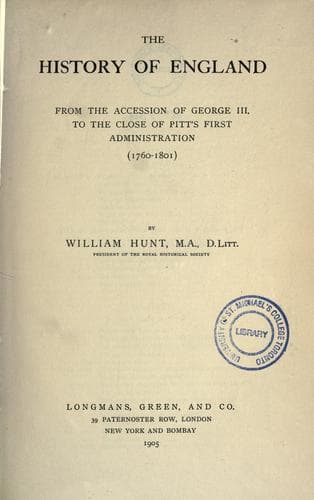
The history of England, from the accession of George III. to the close of Pitt's first administration, 1760-1801Hunt, William
History
The history of England, from the accession of George III. to the close of Pitt's first administration, 1760-1801
Hunt, William
Great Britain -- History -- George III, 1760-1820
Yet Englishmen must ever reverence his memory, for
he loved England with all the ardour of his soul, and, as Richmond said
as he praised him to his face on the day that he was stricken for death,
"he raised the glory of the nation to a higher pitch than had been known
at any former period".
In 1778 the losses and expenses of the war and disappointment at its
results began to work a change in the feeling of the country. In
parliament tories sometimes voted with the opposition. North continued
to strive in vain to be released from office. He made some overtures to
the opposition. Fox, in spite of the violence of his attacks, was
anxious for a coalition, which would have given him office, though he
held first that Germain only, and in 1779 that North himself and
Sandwich, must be excluded.[140] He was restrained by Rockingham, and
North's efforts failed. The death of Chatham, though it united the
opposition, on the whole strengthened the ministry, and in June, 1778,
it gained in ability by the appointment of Thurlow as chancellor and
Wedderburn as attorney-general. Burgoyne, who was unfairly treated by
Germain, was defended by Fox, and on his return joined the opposition.
The struggle in parliament had a constitutional importance not
overlooked by either party. On the issue of the American war, "the
king's war" as it was called, depended the question whether George would
be able to establish his system of government by influence. The
opposition reckoned on failure in America, and hoped that, by exposing
the errors and corrupt practices of the government, they would so rouse
public feeling that, when the war ended in national humiliation, the
king would be forced to accept a minister imposed on him by his people.
No party can reckon on national humiliation as a means of attaining its
ends, however praiseworthy they may be, without serious consequences to
its own character. When England was in extreme peril, the opposition,
and Fox above all, magnified her losses, encouraged her enemies by
exposing her weakness, and, not content with insisting on the
maladministration of the government, cavilled at every measure proposed
for the defence of her empire. Their conduct irritated their
fellow-countrymen, for the spirit of the nation was roused by the
intervention of France in the war with the colonies.
[Sidenote: _ADMIRALTY ABUSES._]
Public-domain text, read in full here on John Shaqi.
Reviews
Reviews
No reviews yet
Be the first to share your thoughts on this work.
Elsewhere in the archive
Join the Discussion
Join the discussion
Sign in to leave a comment or review.
Sign InorCreate an account