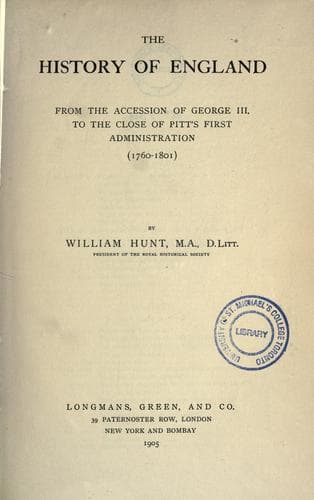
The history of England, from the accession of George III. to the close of Pitt's first administration, 1760-1801Hunt, William
History
The history of England, from the accession of George III. to the close of Pitt's first administration, 1760-1801
Hunt, William
Great Britain -- History -- George III, 1760-1820
The failure of the attempt to obtain relief from commercial restrictions
taught the Irish that England would not sacrifice her own interests to
relieve their distress, and that they must help themselves. Following
the example of the Americans, they formed associations for
non-importation. These associations showed the English manufacturers
that Ireland could retaliate upon them. England was, however, forced to
concession by another means. The assent of the Irish parliament to
England's proposal that drafts should be sent to the war from the 12,000
men who should have been kept for the defence of the country, reduced
the number of troops in Ireland to less than 5,000. The coasts were
infested by privateers and a French invasion was expected. England had
no troops to spare and her fleets were fully engaged. Abandoned by
government, the Irish protestants took up arms to defend their own
country. The Duke of Leinster and Lord Charlemont threw themselves
eagerly into the movement, which was supported by the majority of the
Irish gentry, catholics as well as protestants; though for some time the
catholics did not volunteer because they were disqualified from bearing
arms. Before long 42,000 volunteers were learning military discipline,
arms were purchased and officers chosen. The Irish government regarded
the movement with uneasiness, but took advantage of it as a protection
against invasion, and distributed 16,000 stands of arms among the corps.
The volunteers, while thoroughly loyal, adopted a distinctly national
policy. England was in difficulties and could not withstand the demands
of so powerful a body. In the session of 1779-80 parliament, at North's
instance, abandoned the system of restriction on Ireland's trade; threw
open to her trade with the colonies and repealed the acts restraining
the exportation of her woollens and glass. About the same time the
influence of the volunteers procured the assent of government to a bill
releasing Irish dissenters from the sacramental test. Great as these
gains were, Irish aspirations reached further. On April 19, 1780,
Grattan proposed a declaration of legislative independence. For that the
Irish parliament was not ready. Lord Buckinghamshire, the viceroy,
secured support by lavish promises of recommendations for peerages and
other good things, and parliament deserted the popular cause. In
December, Buckinghamshire was succeeded by Lord Carlisle.
[Sidenote: _AGITATION FOR ECONOMICAL REFORM._]
Public-domain text, read in full here on John Shaqi.
Reviews
Reviews
No reviews yet
Be the first to share your thoughts on this work.
Elsewhere in the archive
Join the Discussion
Join the discussion
Sign in to leave a comment or review.
Sign InorCreate an account