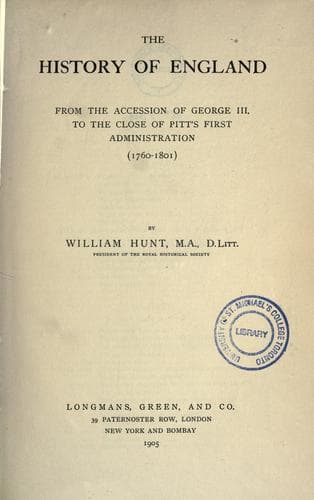
The history of England, from the accession of George III. to the close of Pitt's first administration, 1760-1801Hunt, William
History
The history of England, from the accession of George III. to the close of Pitt's first administration, 1760-1801
Hunt, William
Great Britain -- History -- George III, 1760-1820
During 1779 North's government lost ground; the ministers were known to
be divided in opinion, and various parliamentary inquiries into the
conduct of the war revealed much maladministration. Even the king said
that Germain was "of no use in his department," and Fox's vote of
censure on the admiralty was supported by a minority of 170. Some
changes in the ministry failed to strengthen it. In 1778 Jenkinson
succeeded Barrington as secretary at war; he lived to prove himself a
man of ability, but in his new office he, like his predecessor, had
merely to carry out the orders of others. Gower, a strong advocate of
American coercion in 1775, changed his opinions, resigned the
presidentship of the council in November, 1779, and made a violent
attack on the government. He was succeeded by Lord Bathurst the
ex-chancellor. Suffolk died and was succeeded as southern secretary by
Lord Stormont, and Weymouth, the northern secretary, by Hillsborough.
North still urged the king to accept his resignation. George, conscious
of the shortcomings of the ministry, gave Thurlow authority to treat
with Shelburne, as head of the Chatham party, with a view to the
formation of a strong administration, composed of men of different
parties, to be formed without North, and independently of the existing
ministry. Grafton persuaded Shelburne not to act apart from the
Rockingham whigs. The united opposition would have insisted on a
complete change of measures as well as of men, which would have implied
the surrender of America. To this George would not consent, and North
was again persuaded to remain in office. On the meeting of parliament in
November, 1779, the ministers carried the address by 233 to 134, a
majority which bore out the assertion of the king's speech that
parliament was with him, and the speech added "my people at large".
Public-domain text, read in full here on John Shaqi.
Reviews
Reviews
No reviews yet
Be the first to share your thoughts on this work.
Elsewhere in the archive
Join the Discussion
Join the discussion
Sign in to leave a comment or review.
Sign InorCreate an account