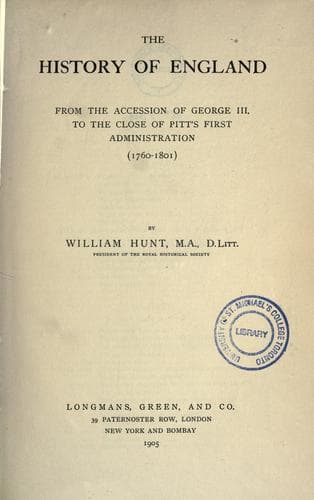
The history of England, from the accession of George III. to the close of Pitt's first administration, 1760-1801Hunt, William
History
The history of England, from the accession of George III. to the close of Pitt's first administration, 1760-1801
Hunt, William
Great Britain -- History -- George III, 1760-1820
Meanwhile a sharp struggle went on in the commons. A proposal for an
account of patent places was agreed to, but another for submitting a
list of pensions was lost by two votes. A crowded meeting was held at
Westminster on April 5 and was addressed by Fox who, with vehement
eloquence, recommended annual parliaments and an addition of 100 county
members as a means of freeing parliament from the influence of the
crown. Government apprehended an attempt to overawe parliament and
stationed soldiers in the neighbourhood of Westminster Hall. This step
enraged the opposition, and on the 6th Dunning proposed a resolution in
the commons that "the influence of the crown has increased, is
increasing, and ought to be diminished". This resolution was carried,
with a trifling addition, by 233 to 215, and another that the house was
competent to correct abuses in the civil list was adopted without a
division. On the 10th, however, a resolution that certain officers of
the household should be disqualified from sitting in the house of
commons was carried by two only. So far did pressure from without
combined with the near prospect of a general election carry the commons,
but the majority did not desire reform and would go no further than
general resolutions. An address to the king, praying that he would not
dissolve nor prorogue parliament until measures had been taken to
diminish the influence of the crown, was rejected by a majority of
fifty-one. The struggle was over, and Fox vented his rage and
disappointment in a speech of unmeasured invective. Throughout the
session much heated language was used in parliament, and both Shelburne
and Fox fought duels in consequence of words uttered by them in debate.
On June 2 Richmond, ultra-democratic as a democratic noble is wont to
be, specially on questions not affecting his own order, was urging
annual parliaments and manhood suffrage on the lords when he was
interrupted by an outbreak of mob violence, a bitter answer to his
arguments.
[Sidenote: _THE GORDON RIOTS._]
Public-domain text, read in full here on John Shaqi.
Reviews
Reviews
No reviews yet
Be the first to share your thoughts on this work.
Elsewhere in the archive
Join the Discussion
Join the discussion
Sign in to leave a comment or review.
Sign InorCreate an account