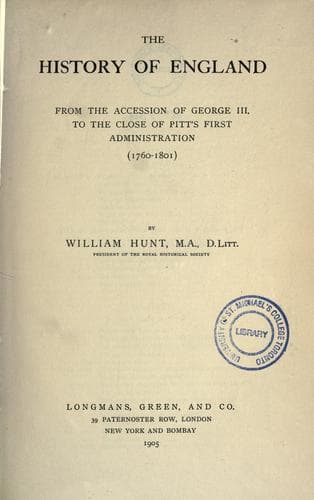
The history of England, from the accession of George III. to the close of Pitt's first administration, 1760-1801Hunt, William
History
The history of England, from the accession of George III. to the close of Pitt's first administration, 1760-1801
Hunt, William
Great Britain -- History -- George III, 1760-1820
Yet though the declaration of war by Spain called forth a loyal address,
unanimously voted by the commons, assuring the king of their help
against the Americans, many held that it would be well to withdraw the
troops from America and use the whole strength of the country against
its foreign enemies. The expenses of the war were heavy; additions were
made to the public debt of L6,000,000 in 1778, of L7,000,000 in 1779,
and of L12,000,000 in 1780, and many new taxes were imposed. At the same
time large sums were expended on maintaining useless offices, a crowd of
pensioners, and other abuses, the means by which the king kept his hold
on parliament. The whigs determined to take advantage of the demands
made on the nation to strike at the root of that corrupt influence by
insisting on public economy. The attack was begun unsuccessfully in the
lords by Richmond and Shelburne, and in December Burke gave notice that
he would lay a plan of economical reform before the commons. The whigs
sought to bring pressure to bear on parliament by an appeal to the
people and met with a ready response. A county meeting at York, presided
over by Sir George Savile, sent a petition to the commons for public
economy, and formed an association to promote that object and the
restoration of the independence of parliament. Twenty-five other
counties and some cities and towns sent similar petitions and most of
them formed associations. On February 11, 1780, Burke introduced his
plan in a speech of remarkable ability. He proposed a reform of the
king's civil establishment, the abolition of a crowd of court offices, a
reform of certain public departments, the limitation of pensions, the
sale of the crown lands, and the abolition of the jurisdictions of
Wales, Cornwall, Chester, and Lancaster. His bills were destroyed
piecemeal in committee, and the only result of his scheme which, if
fully carried out, would, he calculated, have saved the nation over
L1,000,000 a year, was the abolition of the board of trade.
Public-domain text, read in full here on John Shaqi.
Reviews
Reviews
No reviews yet
Be the first to share your thoughts on this work.
Elsewhere in the archive
Join the Discussion
Join the discussion
Sign in to leave a comment or review.
Sign InorCreate an account