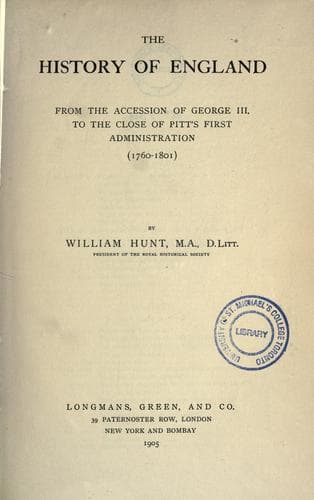
The history of England, from the accession of George III. to the close of Pitt's first administration, 1760-1801Hunt, William
History
The history of England, from the accession of George III. to the close of Pitt's first administration, 1760-1801
Hunt, William
Great Britain -- History -- George III, 1760-1820
On June 2, 1780, some 60,000 persons marched under Gordon's leadership
to Westminster with their monster petition. They violently assaulted
many peers and compelled members of both houses to cry No popery! and to
put blue cockades in their hats. Gordon addressed them, and named Burke
and other members as specially hostile to their cause. The commons
refused to give the petition immediate consideration; the lobbies were
thronged by the mob, and North sent for the lifeguards to protect
parliament. On their arrival the mob left palace-yard and partially
destroyed the chapels of the Sardinian embassy in Duke street, Lincoln's
inn Fields and the Bavarian embassy in Warwick street, Golden square.
The next day was fairly quiet, but on Sunday, the 4th, finding that no
measures were taken to enforce order, they sacked other catholic chapels
and some houses. By Monday the riots assumed a more dangerous character;
the mob passed out of the leadership of religious fanatics and was bent
on plunder and destruction. East of Charing Cross London was almost at
its mercy. There was no efficient police force; military officers and
soldiers had learnt the risk they would incur by firing on a mob without
the order of the civil power, and the magistrates were for the most part
timid and inactive. Wilkes was an honourable exception, and showed
courage and firmness in dealing with the rioters. Virtually unchecked,
the mob sacked chapels and houses, plundered shops, and burnt Savile's
furniture before his door. During the next two days Newgate was partly
burnt and the prison broken open, the other principal prisons either
destroyed or damaged and the prisoners set at liberty. Some magistrates'
houses were plundered and burnt. Mansfield's house in Bloomsbury square
was sacked and his splendid library, pictures, plate, and furniture
destroyed. By Wednesday night thirty-six fires were blazing in different
parts; volumes of flame were rising from the King's bench and Fleet
prisons, the new Bridewell, and the toll gates on Blackfriars bridge,
and the lower end of Holborn was burning fiercely. A great distillery in
Holborn was wrecked; men and women killed themselves by drinking the
unrectified spirits which were brought into the streets, and others who
were drunk perished in the flames or were buried in the ruins. Attacks
were made on the Bank of England and the Pay Office. Both were guarded
by soldiers, and the rioters were repulsed with heavy loss.
[Sidenote: _THE KING'S PERSONAL INTERVENTION._]
Public-domain text, read in full here on John Shaqi.
Reviews
Reviews
No reviews yet
Be the first to share your thoughts on this work.
Elsewhere in the archive
Join the Discussion
Join the discussion
Sign in to leave a comment or review.
Sign InorCreate an account