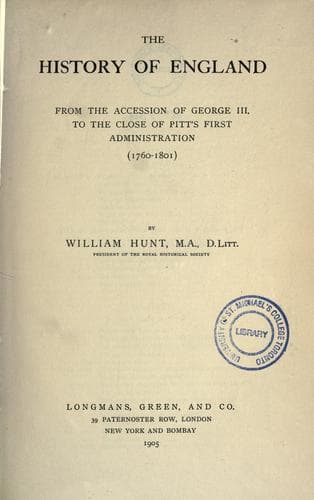
The history of England, from the accession of George III. to the close of Pitt's first administration, 1760-1801Hunt, William
History
The history of England, from the accession of George III. to the close of Pitt's first administration, 1760-1801
Hunt, William
Great Britain -- History -- George III, 1760-1820
By that time the general paralysis of authority was ended by the king's
personal intervention. As his ministers seemed afraid of incurring
responsibility, George summoned a meeting of the council by special
command on Wednesday morning. Finding that the council hesitated to
recommend the employment of troops, he said that if they would not give
him advice he would act without it, and that he could answer for one
magistrate who would do his duty. He bade Wedderburn, the
attorney-general, declare the law on the subject. Wedderburn replied
that the king in council could order soldiers to suppress a riot without
the authority of a magistrate. George at once ordered the military to
act, and by Thursday morning the riots were quelled. Seventy-two houses
and four gaols had been destroyed. Of the rioters, 285 were reported as
killed and 173 wounded, but many more lost their lives during the riots.
The trials of the rioters were conducted with moderation; of the 139 who
were tried, fifty-nine were capitally convicted, and of these only
twenty-one were executed. The Surrey prisoners were tried before
Wedderburn, who was made chief-justice of the common pleas and created
Lord Loughborough. Lord George Gordon was acquitted; he was imprisoned
for a libel in 1787, and died in Newgate after having become a jew. When
the lords, who adjourned on the 6th, again assembled, the great jurist
Mansfield, who in his seventy-sixth year retained his mastery of
constitutional law and his facility of expression, authoritatively
declared that soldiers equally with civil persons might, and if required
by a magistrate must, assist in suppressing riots and preventing acts of
treason and felony, and that the red coat of a soldier neither
disqualified him from performing the duty of a citizen nor would protect
him if he transgressed it. The riots seem to have improved the position
of the government, for the appeal to popular feeling and the formation
of associations by which the whigs brought pressure on parliament were
discredited by them, and for the moment common danger allayed political
animosity.
FOOTNOTES:
[135] _Parl. Hist._, xix., 368-70, 409, 411, 509-12.
[136] The Bute Transaction, MSS. Pitt Papers 14; Stanhope, _History_,
vi., 213.
[137] Lecky, _History_, iv., 83.
[138] Rockingham to Chatham, Jan. 21, 1778, _Chatham Corr._, iv., 488;
Burke to Rockingham, Nov. 5, 1777, _Works_, ii., 357.
[139] _Memorials of C. J. Fox_, i., 211-12; Sir G. C. Lewis,
_Administrations of Great Britain_, p. 16.
[140] _Memorials of C. J. Fox_, i., 180, 306-23.
[141] These figures present a difficulty. The votes 1771-78 appear to
have been, for ordinary expenses L3,303,233, for 'extraordinaries'
L2,232,694 = L5,535,927. Clowes, _Royal Navy_, iii., 327.
[142] On this subject generally see _Parl. Hist._, xix., 728-30, 818-34,
874-95, xx., 204-38, 372 _sqq._; Mahan, _Influence of Sea Power_, pp.
337-41; MS. Admiralty Miscell., 567, R.O.; Keppel, _Life of Keppel_,
ii., 15, 19, 21.
Public-domain text, read in full here on John Shaqi.
Reviews
Reviews
No reviews yet
Be the first to share your thoughts on this work.
Elsewhere in the archive
Join the Discussion
Join the discussion
Sign in to leave a comment or review.
Sign InorCreate an account