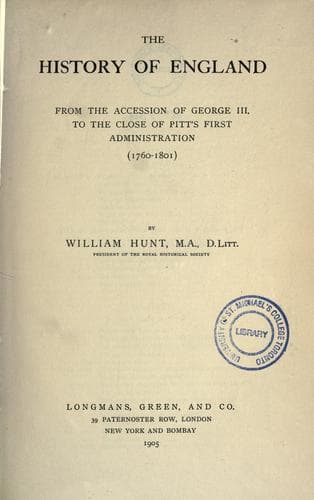
The history of England, from the accession of George III. to the close of Pitt's first administration, 1760-1801Hunt, William
History
The history of England, from the accession of George III. to the close of Pitt's first administration, 1760-1801
Hunt, William
Great Britain -- History -- George III, 1760-1820
The Dutch complained that England violated a treaty made with them in
1674, which provided that either power should hold all goods conveyed in
the ships of the other, not being contraband, as free from liability of
seizure, and that either should be free to trade with the enemies of the
other. Many Dutch ships were searched and their cargoes seized by
English ships, in some cases lawfully, because they were carrying
contraband of war, in others merely because they were carrying French
goods or were trading with our enemies. England contended that the
treaty of 1674 was superseded by the treaties of 1678 and 1716, which
provided that, when either power was attacked, the other should come to
its aid; and that, though the aid of the Dutch was not demanded, they
were at least bound to abstain from helping her enemies. The Dutch,
however, supplied the Americans with vast quantities of naval and
military stores, supplied naval stores also to France and Spain, and
allowed American privateers, and notably Paul Jones, to refit and equip
their ships and to sell their prizes in Dutch ports. The British
ambassador, Sir Joseph Yorke, remonstrated strongly against these
unfriendly acts on the part of a nation in close alliance with his
sovereign. He could gain no satisfaction; for though the party of the
stadholder was anxious to keep on friendly terms, the pensionary and the
city of Amsterdam were violently opposed to England, and the merchants
generally were on their side. Late in 1779 a fleet of Dutch merchantmen,
laden with timber and naval stores for France, and sailing under the
convoy of an admiral, was met by an English squadron. The Dutch fired on
the boats sent to search their ships; the English returned the fire,
captured some of the ships, and brought them into Spithead. Bitter
complaints were made on both sides, and the Dutch, encouraged by the
declaration of the armed neutrality and the influence of France and
Prussia, showed no inclination to yield to Yorke's remonstrances.
Public-domain text, read in full here on John Shaqi.
Reviews
Reviews
No reviews yet
Be the first to share your thoughts on this work.
Elsewhere in the archive
Join the Discussion
Join the discussion
Sign in to leave a comment or review.
Sign InorCreate an account