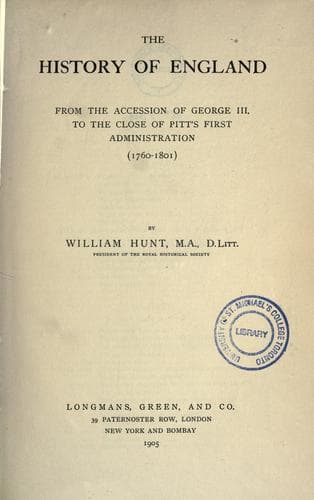
The history of England, from the accession of George III. to the close of Pitt's first administration, 1760-1801Hunt, William
History
The history of England, from the accession of George III. to the close of Pitt's first administration, 1760-1801
Hunt, William
Great Britain -- History -- George III, 1760-1820
[143] Mahan, _Influence of Sea Power_, pp. 421 _sqq._, 523 _sqq._
[144] Hannay, _Rodney_, pp. 117-31; Mahan, _Influence of Sea Power_, pp.
378-81.
CHAPTER XI.
YORKTOWN AND THE KING'S DEFEAT.
In 1780 England's enemies increased in number and her isolation was
complete. From early times all belligerent nations subjected to capture
the goods of an enemy in neutral ships. This usage was interrupted only
by treaties. It was specially disliked by the Dutch, as great carriers
by sea, and they made many treaties with different powers, stipulating
that goods carried in their ships, not being contraband, should be free.
In 1778 France, in order to injure England, declared its adoption of the
principle that neutral ships made neutral goods. The lesser Baltic
nations, which largely exported naval material, were anxious to protect
their commerce from England, specially as she was rigorous in her view
with regard to contraband goods; and they looked to Russia to help them.
Frederick of Prussia, always eager to do England a bad turn, used his
influence with the Empress Catherine in the cause of the freedom of
commerce in neutral ships, and was supported by her minister, Panin.
Catherine, though not unfriendly towards England, yielded to his
representations, and in March, 1780, notified England, France, and Spain
that, while in other respects she would maintain strict neutrality, she
would enforce by her fleets four propositions: (1) that neutral ships
may freely sail from port to port of a belligerent nation; (2) that
goods carried by them, not being contraband, should be free from
seizure; (3) that only certain specified goods were contraband; and (4)
that no blockade should be recognised which was not effectual. France,
Spain, and the Americans at once accepted these propositions; Denmark,
Sweden, Prussia, and the Emperor joined the league of "armed neutrality"
in the course of the year, and the accession of Holland was only
prevented by its becoming a belligerent. England did not accept these
new rules, which were detrimental to her as a naval power. The alliance
isolated her, threatened to increase the number of her enemies, and
forced her to be cautious in her dealings with neutral ships. War with
the Baltic powers would have ruined her, for since the American revolt
she was dependent on these countries for timber and other naval stores.
Happily, Catherine was by no means inclined to quarrel with her.
[Sidenote: _THE QUARREL WITH HOLLAND._]
Public-domain text, read in full here on John Shaqi.
Reviews
Reviews
No reviews yet
Be the first to share your thoughts on this work.
Elsewhere in the archive
Join the Discussion
Join the discussion
Sign in to leave a comment or review.
Sign InorCreate an account