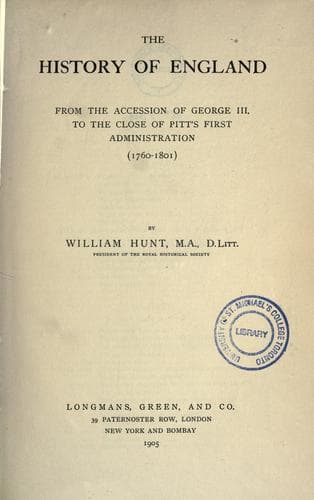
The history of England, from the accession of George III. to the close of Pitt's first administration, 1760-1801Hunt, William
History
The history of England, from the accession of George III. to the close of Pitt's first administration, 1760-1801
Hunt, William
Great Britain -- History -- George III, 1760-1820
The king's influence was strong in the new parliament. Sir Fletcher
Norton, a bad-tempered and unprincipled man, who had deeply offended him
by his speech with reference to the civil list in 1777, was again
proposed as speaker by the opposition, and was rejected by 203 votes to
134 in favour of Cornwall, the ministerial candidate. The session opened
languidly and the attendance of the opposition was scanty. After the
Christmas recess the struggle with the government was carried on with
more energy. Little ground was gained. Burke's bill for a reform of the
civil list establishment was rejected by 233 to 190, and a like fate
attended other efforts to destroy the means by which parliament was
subjected to corrupt influences. Though the Dutch war was popular
specially with the mercantile class, which expected to benefit by it,
both the nation and the parliament were thoroughly weary of the
American war, and the opponents of it in the commons were strengthened
by the accession of Pitt who pronounced it "a most accursed, wicked,
barbarous, cruel, unnatural, unjust, and diabolical war".[148] Yet the
news of successes in the south, of a mutiny of the Pennsylvania troops
in January, 1781, and of the distress and financial difficulties of the
Americans encouraged the government party. Motions hostile to the war
were feebly supported, and Fox's jeers at British victories, and his
declarations that the money spent on the war was plundered from the
nation, that the cause of the Americans was "the cause of freedom, of
the constitution, and of whiggism, and that he had in its origin wished
it success," excited justifiable indignation.
The most serious attack on the government was caused by North's
disgraceful manipulation of a loan of L12,000,000. Though more than
three times the amount was offered, the loan was arranged on terms so
advantageous to the lenders that the price of the new stock rose at once
from 9 per cent. to 11 per cent. above par. The profits were calculated
by Fox to amount to L900,000, and, as in 1763, the loan was distributed
among the supporters of the government, half of it, so it was said,
going to members of the house of commons, whether as compensation for
election expenses or generally as a means of maintaining a corrupt
influence. North's conduct was severely reprehended in both chambers,
and in two divisions on the question in the commons the opposition voted
106 to 137 and 163 to 209. The life of the government depended on the
fortunes of the war in America; it was prolonged by gleams of success;
it was soon to be terminated by an overwhelming disaster.
Public-domain text, read in full here on John Shaqi.
Reviews
Reviews
No reviews yet
Be the first to share your thoughts on this work.
Elsewhere in the archive
Join the Discussion
Join the discussion
Sign in to leave a comment or review.
Sign InorCreate an account