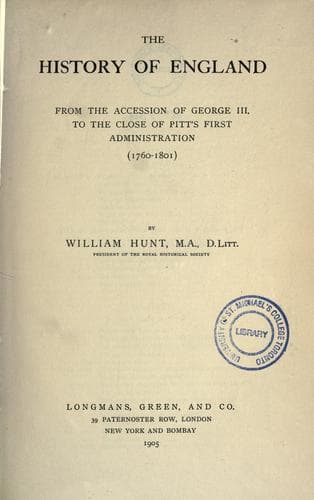
The history of England, from the accession of George III. to the close of Pitt's first administration, 1760-1801Hunt, William
History
The history of England, from the accession of George III. to the close of Pitt's first administration, 1760-1801
Hunt, William
Great Britain -- History -- George III, 1760-1820
In the summer of 1780 the Americans were, perhaps, more disheartened
than at any other period of the war. They were, as we shall see, losing
in the south, and their hope of decisive help from France was again
disappointed. Congress continued to issue paper money until its notes
became of so little value that ten paper dollars were exchanged for a
cent; there was no money and no credit, and Washington was forced to
levy contributions on the surrounding country to supply his army. The
people generally were sick of the war. France was almost bankrupt; even
Vergennes was weary of American demands for help, and suggested putting
an end to the war by a long truce, the English surrendering New York and
keeping Georgia and South Carolina. The idea was equally displeasing to
the king and to the Americans. It was not without reason that George
believed that "America was distressed to the greatest degree," and that
if his ministers persevered in the war they would wear down its power of
resistance.[149]
[Sidenote: _MAJOR ANDRE._]
The depression of the Americans was deepened by the treachery of Arnold.
Conspicuous among their generals for energy and dash, he was a
vulgar-minded, irritable man, ruined in fortune by his own extravagance,
and with many enemies. He had been treated badly by congress, and was
finally maddened by receiving a public reprimand ordered by a
court-martial which was held to examine charges affecting his probity.
Washington felt kindly towards him, and gave him the command of West
Point, a highland fortress which was the key of the line of the Hudson.
He had for some time contemplated deserting to the British, and was in
correspondence with Clinton, receiving replies through Major Andre, a
gallant and popular young officer, Clinton's adjutant-general, who wrote
under the name of John Anderson. Determined to avenge himself on
congress, he offered to betray West Point to the British. An attack was
to be made on September 25, and Arnold was to arrange the American
troops in such a way as to ensure its success. Had the plot succeeded,
the Americans would have lost communication between the northern and
southern provinces, and would probably have been forced to give up the
struggle. An interview was necessary, and Andre sailed up the river in
the _Vulture_ sloop, and met Arnold secretly on the night of the 21st.
After the interview Arnold persuaded him to take shelter in a house
which, though he was not aware of it, stood within the American lines,
and gave him papers containing arrangements for the attack. The next day
Andre could not find a boatman to take him to the _Vulture_, and was
forced to set out for New York by land. He had a pass from Arnold made
out for John Anderson, he changed his uniform for a civilian dress, and
passed the American lines in safety. On the 23rd he fell into the hands
of some American cattle-stealers; Arnold's papers were found in his
boots, and his captors handed him over to a militia officer. Arnold
Public-domain text, read in full here on John Shaqi.
Reviews
Reviews
No reviews yet
Be the first to share your thoughts on this work.
Elsewhere in the archive
Join the Discussion
Join the discussion
Sign in to leave a comment or review.
Sign InorCreate an account