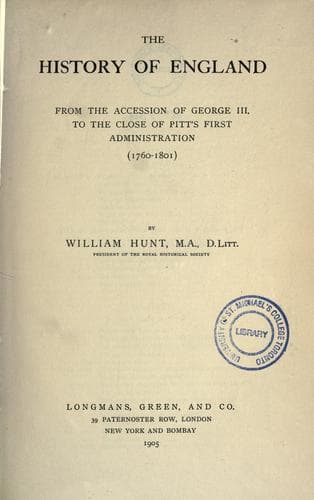
The history of England, from the accession of George III. to the close of Pitt's first administration, 1760-1801Hunt, William
History
The history of England, from the accession of George III. to the close of Pitt's first administration, 1760-1801
Hunt, William
Great Britain -- History -- George III, 1760-1820
Cornwallis was encouraged to pursue his grand plan of "conquest from
south to north". Clinton, though he did not approve of his forward
policy,[154] sent General Leslie with 3,200 men to Chesapeake bay to
co-operate with him, and Cornwallis entered North Carolina and advanced
as far as Charlotte. In spite of his brilliant victory he was beset by
difficulties. The loyalists did not give him the help which he expected;
as soon as he left South Carolina it broke into a ferment of
disaffection, and his troops were not suited for the guerilla warfare
largely adopted by the enemy, who were, Rawdon wrote, "mostly mounted
militia not to be overtaken by our infantry, nor to be safely pursued in
this strong country by our cavalry".[155] In this as in many other
respects, the experiences of the war were repeated in South Africa in
our own day. Before Cornwallis left South Carolina he detached a force
of 800 militia and 100 regulars under Major Ferguson to scour the border
and keep the country quiet in the rear of the army. They were met by a
partisan army of 3,000 men under different leaders at King's Mountain on
October 7; Ferguson was killed and all his men were either slain or
captured. So severe a loss, combined with the anxiety of Cornwallis lest
the important post called Ninety-six should be taken, put a stop to any
further advance. Cornwallis fell back on Winnsborough, and bade Leslie
convey his force to Charleston, which he was able to do as England had
command of the sea, and reinforce him. The safety of the border was his
first care. No sooner had Tarleton checked the inroads of Marion in the
east than he was summoned westwards to protect Ninety-six from Sumter.
He engaged Sumter's force at Blackstock on November 20, and claimed to
have defeated him. Tarleton was a dashing cavalry officer, given to
overrating his own achievements. His troops were few and weary, and at
best he escaped defeat; but Sumter's band dispersed, for its leader was
wounded and disabled for a while from further action.[156]
[Sidenote: _BATTLE OF THE COWPENS._]
Public-domain text, read in full here on John Shaqi.
Reviews
Reviews
No reviews yet
Be the first to share your thoughts on this work.
Elsewhere in the archive
Join the Discussion
Join the discussion
Sign in to leave a comment or review.
Sign InorCreate an account