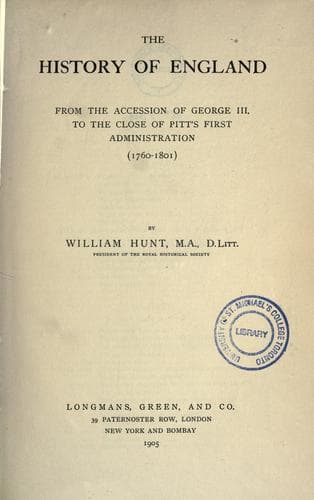
The history of England, from the accession of George III. to the close of Pitt's first administration, 1760-1801Hunt, William
History
The history of England, from the accession of George III. to the close of Pitt's first administration, 1760-1801
Hunt, William
Great Britain -- History -- George III, 1760-1820
Before Clinton left South Carolina, he issued a proclamation which put
an end to all hopes of neutrality; those who would not fulfil the duties
of loyal subjects would be held to be rebels. This step caused many who
would willingly have remained neutral to join the revolutionists rather
than fight against them. The country soon became disturbed; the British
were forced to act with severity, and the Americans, both revolutionists
and loyalists, behaved with great cruelty towards their
fellow-countrymen of the opposite party.[153] Partisan leaders, among
whom Sumter and Marion were conspicuous, raised bands on their own
responsibility, and fought against the British, acting sometimes
independently and sometimes in conjunction with the forces of congress.
Cornwallis worked energetically at Charleston, enrolling militia and
providing for the administration, while Lord Rawdon with the main body
of the army kept the border at Camden. Anxious to press on, Cornwallis
desired Clinton to send a force to Chesapeake bay, to divert the enemy
while he invaded North Carolina; but before he could advance further he
had to fight for the southern province. Gates was appointed to the
supreme command in the south and was threatening Camden. Cornwallis
hastened thither with his staff and found Rawdon with 700 sick and less
than 2,000 fit for duty. The enemy was greatly superior in number,
without reckoning 1,000 men under Sumter, who was cutting the British
off from their supplies on the west side of the Wateree river.
Cornwallis met them on August 16, and began the engagement with a
vigorous attack on the American left, formed by the Virginia and North
Carolina militia who, as the British advanced, firing and cheering,
threw down their arms and fled. The British victory was complete; the
Americans lost about 1,000 killed and wounded, over 1,000 prisoners, and
their artillery and stores; the British casualties were 324. Two days
later Colonel Tarleton smartly surprised Sumter, and dispersed his band,
retaking a convoy which had fallen into his hands shortly before the
battle of Camden. The defeat of Gates's army drove the Americans almost
to despair.
Public-domain text, read in full here on John Shaqi.
Reviews
Reviews
No reviews yet
Be the first to share your thoughts on this work.
Elsewhere in the archive
Join the Discussion
Join the discussion
Sign in to leave a comment or review.
Sign InorCreate an account