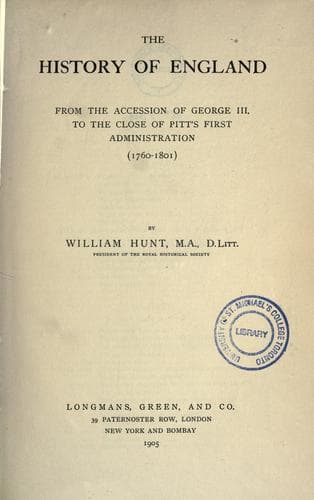
The history of England, from the accession of George III. to the close of Pitt's first administration, 1760-1801Hunt, William
History
The history of England, from the accession of George III. to the close of Pitt's first administration, 1760-1801
Hunt, William
Great Britain -- History -- George III, 1760-1820
Cornwallis, finding it difficult to support his troops and being anxious
to encourage the loyalists by showing his superiority in the field,
accepted Greene's offer of battle at Guilford courthouse on March 15.
His force scarcely numbered 2,000, while the enemy, regulars and
militia, were 4,300 strong. The battle was begun by the British left,
consisting of the 22nd and 23rd regiments, supported by grenadiers and
guards, which charged and routed the first line of the enemy with the
bayonet. The second line, formed by Virginians, stood steady and was not
driven back without a severe struggle; so too the First Maryland
regiment, in the third line, repulsed the first attack upon it with
heavy loss. The Second Marylanders fell back before a battalion of
guards, who pressed heedlessly after them and were suddenly engaged by
the American dragoons. The guards fought fiercely, but were broken. For
a moment things looked awkward. Then the enemy was checked by the
British artillery and the guards were rallied by their brigadier O'Hara,
who, though severely wounded, was still able to do good service. The
British fought magnificently and won a brilliant victory. Yet it was
dearly bought, for the loss of over 500 rank and file, a full third of
his infantry, left Cornwallis powerless. His little army was in need of
supplies and he marched to Wilmington, where stores brought by sea were
laid up for him.
[Sidenote: _CORNWALLIS ADVANCES INTO VIRGINIA._]
Being too weak to do anything further without reinforcements, he decided
to leave the Carolinas, effect a junction with Arnold in Virginia, and
attempt the conquest of that province, reckoning that success there
would check disaffection in South Carolina and ultimately tend to the
conquest of North Carolina.[157] He wished Clinton to prosecute the war
in Virginia with all the strength at his command, even at the expense of
giving up New York. Clinton, however, was throughout opposed to his
forward policy; he would have had him attempt nothing beyond the power
of the force which he left with him, "the defence of South, and most
probably the reduction of North, Carolina," and he did not intend the
troops sent to Virginia to engage in "solid" operations, which he judged
to be inadvisable until he should himself take the field. The king and
the cabinet approved Cornwallis's line of action.[158] He advanced into
Virginia on his own responsibility. This step led to unfriendly
relations between the two commanders, and after the war was the subject
of a bitter controversy between them. Cornwallis effected a junction
with Arnold's army on May 20, and in command of over 5,000 troops
overran the province, Lafayette, with a far inferior force, retreating
before him. Meantime Rawdon struggled gallantly, though unsuccessfully,
against Greene in South Carolina. He defeated Greene at Hobskirk hill on
April 25, but was forced to retire from Camden. The loyalists saw that
Public-domain text, read in full here on John Shaqi.
Reviews
Reviews
No reviews yet
Be the first to share your thoughts on this work.
Elsewhere in the archive
Join the Discussion
Join the discussion
Sign in to leave a comment or review.
Sign InorCreate an account