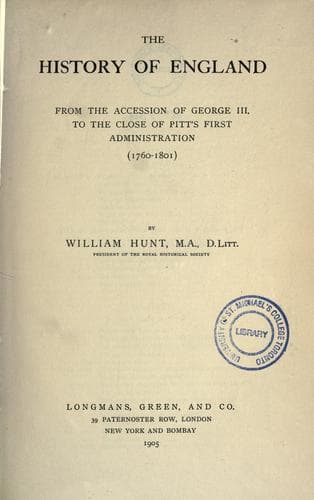
The history of England, from the accession of George III. to the close of Pitt's first administration, 1760-1801Hunt, William
History
The history of England, from the accession of George III. to the close of Pitt's first administration, 1760-1801
Hunt, William
Great Britain -- History -- George III, 1760-1820
the British could not protect them; the whole province was disaffected,
and post after post was taken by Greene, Lee, Sumter, Marion, and other
generals. At last, after Rawdon's return to England on account of
ill-health, a hard-fought battle at Eutaw springs on September 8, which
both sides claimed as a victory, so weakened the British force that it
remained in and about Charleston until it was withdrawn at the end of
the war.
To return to the spring of the year, Cornwallis's invasion of Virginia
and the destruction of property there seemed likely to bring the war to
a successful issue. Washington's army was in grievous want of supplies,
the American marine was annihilated, their finances were in a ruinous
state, and their resources generally almost exhausted. Powerful
co-operation with Cornwallis on the part of Clinton was urgently needed.
The issue of the struggle depended on the power of Great Britain to
prevent a French fleet and army from undertaking a joint enterprise with
the Americans. At this critical juncture England lost the superiority at
sea. In May, Washington and Rochambeau agreed that, as soon as Grasse
brought his fleet over, they would join forces, and either attack New
York or, perhaps, march into Virginia, as circumstances might direct.
Clinton discovered their design, would not spare any troops from New
York, and in June called on Cornwallis to send him part of the force
under his command, and ordered him to take up a defensive position.
Cornwallis retired down the James river to Portsmouth. Clinton withdrew
his demand for troops and directed him to fortify a station on the
Yorktown peninsula as a port for ships. He would there be able to take
up a defensive position secured by access to the sea. Cornwallis
concentrated all his forces, about 7,000 men, and fortified Yorktown and
Gloucester. On July 6 Rochambeau, in expectation of the arrival of
Grasse's fleet, brought his troops from Rhode Island (p. 219) and joined
Washington at White Plains. It was agreed between Grasse and Washington
that the united army, 4,000 French and 2,000 Americans, should march
into Virginia and act in co-operation with the French fleet. Clinton,
however, deceived by fictitious letters, written by Washington and
designed to be intercepted, believed that it would attack New York, and
remained quietly there while it marched half through New Jersey. Not
until September 2 did he discover that it was on its way to join in a
combined attack on Cornwallis. On the 5th it reached the head of
Chesapeake bay.
[Sidenote: _CAPITULATION OF CORNWALLIS._]
Public-domain text, read in full here on John Shaqi.
Reviews
Reviews
No reviews yet
Be the first to share your thoughts on this work.
Elsewhere in the archive
Join the Discussion
Join the discussion
Sign in to leave a comment or review.
Sign InorCreate an account