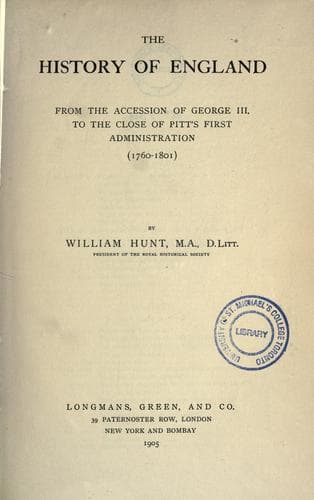
The history of England, from the accession of George III. to the close of Pitt's first administration, 1760-1801Hunt, William
History
The history of England, from the accession of George III. to the close of Pitt's first administration, 1760-1801
Hunt, William
Great Britain -- History -- George III, 1760-1820
On July 1, the day after Fox declared his intention to resign,
Rockingham died. His death delivered George from the domination of the
whigs. He at once bade Shelburne propose a plan for a ministry. The
Rockingham party in the cabinet objected, declaring that they had a
right to advise the king as to his choice, and pressed him to send for
Portland, whose position as a whig magnate constituted his chief claim
to office. George refused to yield to their dictation. Fox would not
serve with Shelburne and resigned the seals. He was followed by only one
member of the cabinet, Lord John Cavendish, by Portland, Burke,
Sheridan, and a few more. Richmond, Keppel, and the rest of the party
remained in office. Shelburne took the treasury, Pitt became chancellor
of the exchequer, and Thomas Townshend succeeded Shelburne, and Lord
Grantham Fox, as secretaries of state. Barre was made paymaster of the
forces, and Lord Temple, afterwards Marquis of Buckingham, the eldest
son of George Grenville, lord-lieutenant of Ireland. Fox was
disappointed to find that so few followed him. Distrusting Shelburne as
he did, he could not do otherwise than resign rather than serve with
him. As, however, the new ministry was a whig ministry, as Shelburne
professed many of the Rockingham principles, and as Pitt, who virtually
had the leadership of the lower house, was at that time a whig, he
should have taken up a neutral position, supporting the government when
he approved of its measures and opposing it when he disapproved of them.
He took another course; at once went into opposition, declared the new
ministers could not be bound either by promises or honour, and
prophesied--after events make his words worth remembering--that they
would soon "be joined by those men whom the house had precipitated from
their seats".[171] Parliament was prorogued on July 11.
Public-domain text, read in full here on John Shaqi.
Reviews
Reviews
No reviews yet
Be the first to share your thoughts on this work.
Elsewhere in the archive
Join the Discussion
Join the discussion
Sign in to leave a comment or review.
Sign InorCreate an account