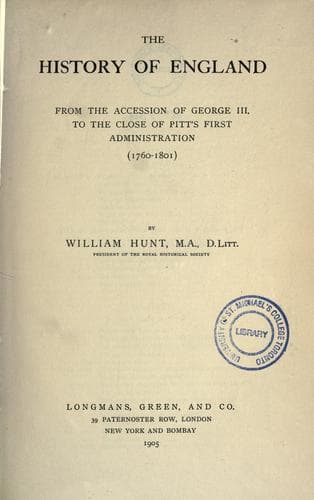
The history of England, from the accession of George III. to the close of Pitt's first administration, 1760-1801Hunt, William
History
The history of England, from the accession of George III. to the close of Pitt's first administration, 1760-1801
Hunt, William
Great Britain -- History -- George III, 1760-1820
The chief business before the new ministry was to arrange terms of
peace. England wished to free the Americans from French influence and to
establish good relations with them by a separate negotiation. Vergennes
hoped to delay the acknowledgment of independence until a general peace,
intending that France should compensate Spain for her disappointment
with respect to Gibraltar by securing for her the sole navigation of the
Mississippi and that the United States should be enclosed by the
Alleghanies. The American commissioners found that France regarded the
success of the revolution, the result of her own work, with jealousy,
and wished to shut them out from the Newfoundland fishery and from
extension on the west and north. On the other hand, England acknowledged
American independence on September 27, and showed herself inclined to
meet their demands in a friendly spirit. Accordingly, without consulting
the French ministers, they signed preliminaries of peace on November 30,
the treaty to be concluded when terms were arranged between England and
France. England acknowledged the sovereignty of the United States; the
Mississippi was recognised as their boundary on the west, and on the
north a line passing through the great lakes; and they secured a right
to fish on the banks of Newfoundland and in the gulf of St. Lawrence.
The American revolution was accomplished. Englishmen of all parties
believed that the day of England's greatness was over. Yet the
separation, bitter and humiliating as it was, taught her a lesson in
colonial government which has rendered her empire strong as well as
vast, while in place of discontented colonies with cramped energies, it
laid the foundation of a mighty power bound to her by bonds which will
grow in strength so long as the affairs of both Great Britain and the
United States are wisely directed. It was a happy beginning of the
relations between the two powers that it was through England, and not
through their foreign allies, that the Americans obtained the
gratification of their legitimate ambitions, and that from the peace
with the United States England gained some advantage in treating with
her continental foes.
Public-domain text, read in full here on John Shaqi.
Reviews
Reviews
No reviews yet
Be the first to share your thoughts on this work.
Elsewhere in the archive
Join the Discussion
Join the discussion
Sign in to leave a comment or review.
Sign InorCreate an account