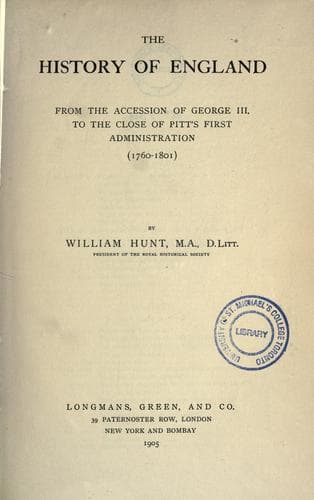
The history of England, from the accession of George III. to the close of Pitt's first administration, 1760-1801Hunt, William
History
The history of England, from the accession of George III. to the close of Pitt's first administration, 1760-1801
Hunt, William
Great Britain -- History -- George III, 1760-1820
were surrendered without bloodshed in 1782, and had already been
recovered not less easily by England; and she guaranteed the right of
the English to cut logwood in the bay of Honduras. A truce with Holland
led to a treaty providing for a mutual restoration of conquests, with
the exception of Negapatam which was retained by England.
When parliament met on December 5, it was evident that the terms of
peace would be sharply criticised by both the parties in opposition, the
followers of North and of Fox. Shelburne was disliked and distrusted by
his colleagues, who considered him secretive and inclined to act alone,
and the government soon showed signs of dissolution. Richmond retired
from the cabinet in January, 1783, though he kept his office; the next
day Keppel resigned the admiralty because he was dissatisfied with the
preliminaries, and Carlisle, the lord steward, also resigned for the
same reason. Shelburne was prevented by his colleagues from making
overtures to North, and Pitt, who stood by him, tried to persuade Fox to
re-enter the ministry. Fox asked if Shelburne would remain, and Pitt
having answered that he would, at once declined. On this Pitt closed the
interview with, it is said, the words: "I did not come here to betray
Lord Shelburne". From that time Pitt and Fox were political enemies. The
Duke of Rutland having succeeded Carlisle as lord steward with a seat in
the cabinet, Grafton declared that Shelburne had no right to make an
addition to the cabinet without consulting its members, and that he was
making himself a "prime minister," and he too resigned the privy seal.
According to the whigs the cabinet was to dictate to the king whom he
should direct to form a cabinet, and was then to control its own
composition. Their constitutional ideas were warped by their desire to
perpetuate their own power.
Public-domain text, read in full here on John Shaqi.
Reviews
Reviews
No reviews yet
Be the first to share your thoughts on this work.
Elsewhere in the archive
Join the Discussion
Join the discussion
Sign in to leave a comment or review.
Sign InorCreate an account